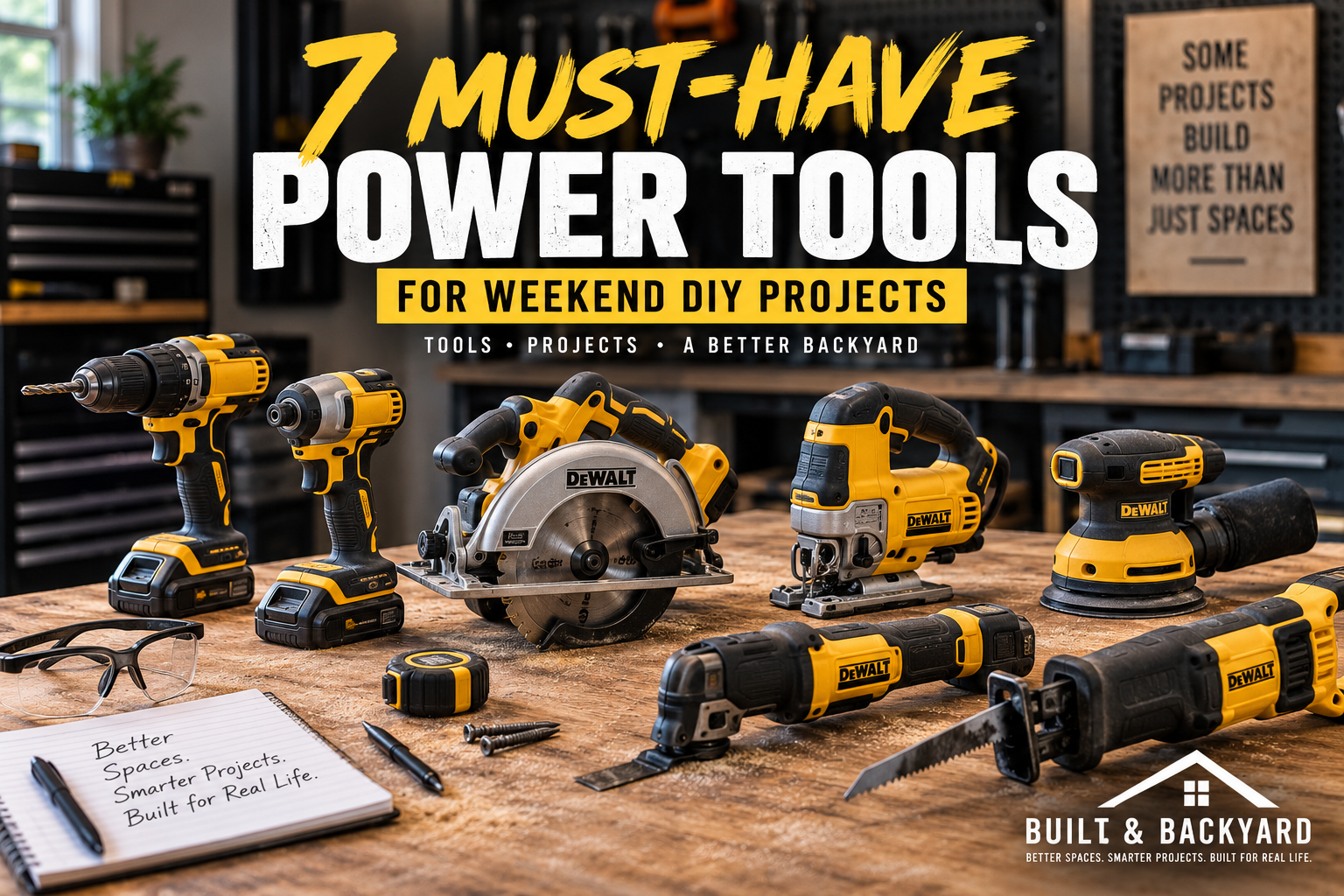
You don’t need a professional workshop to tackle weekend projects around the house. A few dependable power tools can make DIY jobs faster, easier, and a lot less frustrating.
These seven power tools are worth considering if you want to build a practical setup for repairs, upgrades, and weekend projects.
1. Cordless Drill/Driver
A cordless drill/driver is one of the most useful power tools you can own. It handles everything from drilling holes and driving screws to assembling furniture, hanging shelves, and tackling basic home repairs.
For most homeowners, an 18V or 20V model is a solid choice. Look for one with variable speed, multiple clutch settings, and a battery system that works with other tools from the same brand.
Built & Backyard Tip: If you plan to grow your tool collection, pick a battery platform you like and stick with it. Using the same batteries across multiple tools can save money and make your setup much easier to manage.
2. Impact Driver
An impact driver is built for driving screws, bolts, and other fasteners with more force than a standard drill. It’s especially useful for deck projects, framing, installing long screws, and working with tougher materials.
Because it delivers extra torque without requiring as much pressure from you, an impact driver can make bigger DIY jobs feel much easier.
Built & Backyard Tip: A drill and impact driver make a great pair. Use the drill for making holes and the impact driver for driving screws and fasteners.
3. Circular Saw
A circular saw is a versatile tool for cutting lumber, plywood, and other sheet materials. It’s a great choice for projects like building shelves, making simple furniture, repairing decks, or cutting boards to size.
A standard 7-1/4-inch circular saw is a good all-around option for most homeowners. Look for one with an easy depth adjustment, a comfortable handle, and a clear cutting guide.
Built & Backyard Tip: Take your time setting up a straight cutting line before you start. A simple guide or straight edge can make a big difference in how clean your cuts turn out.
4. Jigsaw
A jigsaw is ideal when you need to make curved cuts, cut openings, or work in places where a circular saw isn’t practical. It’s useful for projects involving plywood, countertops, shelving, laminate, and decorative woodworking.
For most weekend DIY work, a corded or cordless jigsaw with variable speed will handle plenty of jobs around the house.
Built & Backyard Tip: The blade makes a big difference. Use a blade designed for the material you’re cutting, and let the saw do the work instead of forcing it through the cut.
5. Random Orbital Sander
A random orbital sander can save a lot of time when you’re smoothing wood, refinishing furniture, preparing surfaces for paint, or cleaning up rough edges on DIY projects.
It moves in a random pattern that helps reduce visible sanding marks, making it easier to get a smooth finish even if you’re not an experienced woodworker.
Built & Backyard Tip: Start with a coarser grit for rough surfaces, then work your way up to a finer grit for a smoother finish. Don’t press down too hard — let the sander do the work.
6. Oscillating Multi-Tool
An oscillating multi-tool is one of the most versatile power tools you can keep around. With the right attachment, it can cut drywall, trim wood, remove grout, scrape adhesive, sand tight spaces, and handle plenty of small repair jobs.
It’s especially useful for projects where larger saws or sanders simply won’t fit.
Built & Backyard Tip: Keep a small assortment of blades and attachments on hand. The tool becomes much more useful when you can quickly switch between cutting, scraping, and sanding.
7. Reciprocating Saw
A reciprocating saw is made for tougher cutting jobs where precision matters less than speed and power. It’s useful for demolition, cutting through old lumber, trimming branches, removing damaged materials, and breaking down larger pieces during renovation projects.
For homeowners, a cordless model can be especially convenient because you can use it around the yard, garage, or house without worrying about an extension cord.
Built & Backyard Tip: Match the blade to the job. Different blades are made for wood, metal, demolition, and pruning, and using the right one makes the saw work much better.
Build a Power Tool Setup That Fits Your Projects
You don’t need every power tool on the market to handle most weekend projects. Start with the tools you’re most likely to use, then add to your collection as your projects get bigger.
A solid drill, saw, sander, and a few versatile specialty tools can cover a huge range of repairs and DIY upgrades around the house.
At Built & Backyard, we focus on practical tools and gear that help you get more done without overcomplicating the job.
Leave a Reply