Disclosure: This post contains affiliate links. If you buy through them, Built & Backyard may earn a commission at no extra cost to you.
Quick answer
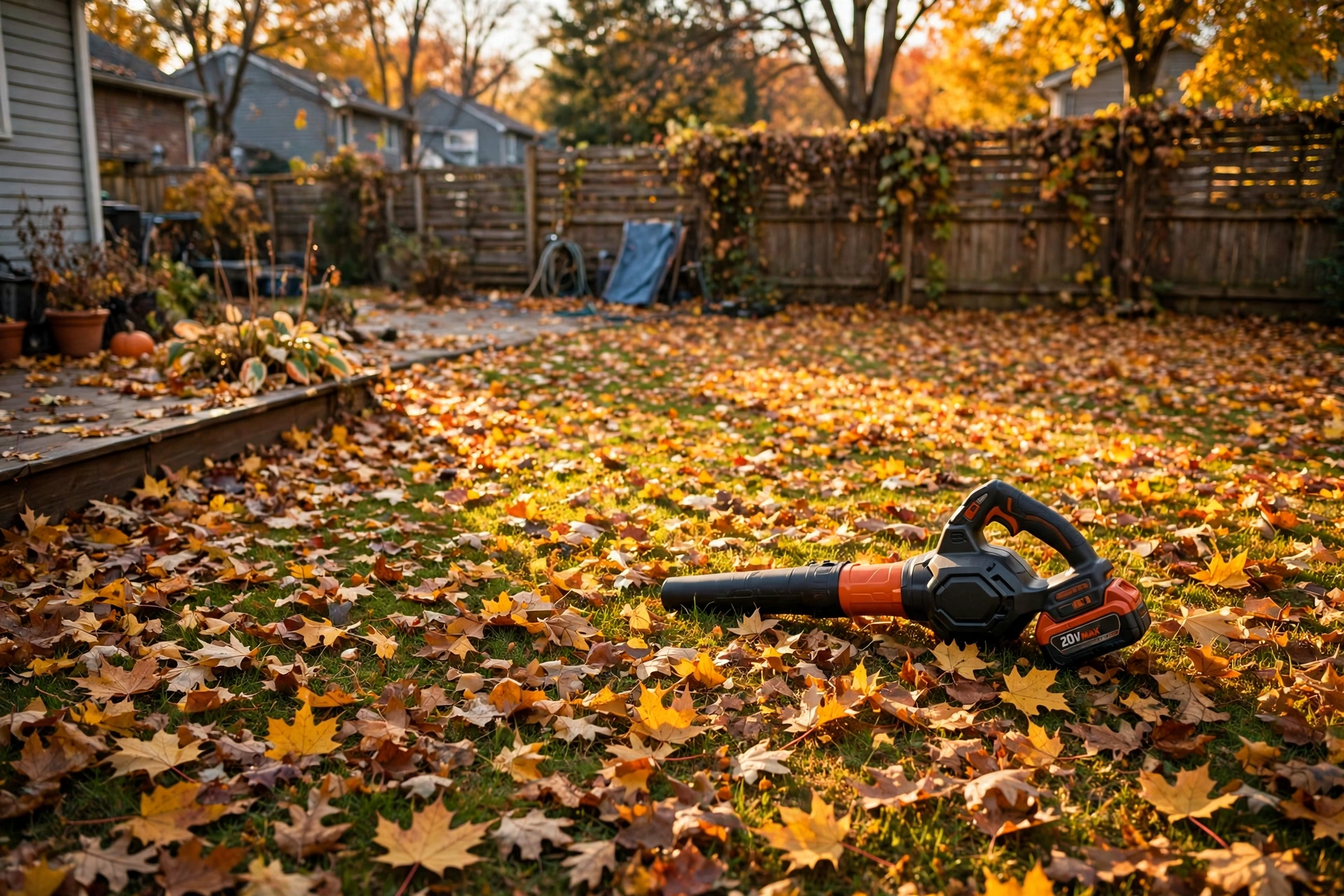
Leaf cleanup comes down to four jobs — move, collect, shred, haul — and most yards need just three tools to do all four: a cordless leaf blower sized to your yard (500+ CFM if you have big trees or wet leaves), a wide lightweight rake, and a tarp or leaf hauler instead of hand-bagging. A 3-in-1 blower/vacuum/mulcher adds the shred step, cutting bag volume by 10–16x. Do it now, not after every leaf has fallen: two passes in late October beat one marathon in November.
First: do you even need to rake?
Honestly, sometimes no. If your leaf layer is light, mulch-mow instead: run your mower over dry leaves with the bag off (or on the mulch setting). Shredded leaves decompose into the soil and feed the lawn — turf programs have recommended this for years. The rule of thumb: if you can still see most of the grass through the shredded leaves, you mulched fine. If the lawn disappears under a solid mat, collect.
This guide is for when mowing it in isn’t an option — heavy cover, thick oak/maple drops, or leaves smothering beds and gutters.
Pick your method by yard size
| Yard situation | Best approach | Key tools |
|---|---|---|
| Small lot, few trees | Rake + tarp | Wide rake, leaf hauler tarp |
| Typical suburban lot | Blow + mulch-mow or collect | 40–60V blower, rake, tarp |
| Half acre+, heavy cover | Blow to rows, shred, bag | High-CFM blower, 3-in-1 vac/mulcher, bags |
| Mostly beds, paths, patio | Sweep + rake | Cordless blower on low, narrow rake |
The common mistake is buying the heaviest tool first. Match the tool to the job: a 765 CFM blower is glorious on a half acre and absurd overkill on a townhouse patio.
What the numbers mean on a blower box
- CFM (cubic feet per minute) — how much air moves. This is the number that matters most: 350–450 CFM handles small yards; 500+ CFM earns its keep on big lots and wet leaves.
- MPH — airspeed. Needs to be 140+ to break apart wet, matted leaves before the CFM can move them.
- Battery platform (V / Ah) — a bigger battery (5.0Ah vs 2.0Ah) can double real runtime. And if you already own tools on a 40V or 56V platform, a bare-tool blower on that same battery line is the cheapest way to get serious power.
Battery blowers run 60–70 dB — comfortably under most HOA noise limits — versus 90–105 dB for gas. Your neighbors will notice the difference.
Our picks
Best cordless blower: EGO Power+ LB7654
The consensus pick across 2026 reviews for a reason: 765 CFM and up to 200 MPH on the 56V platform, with a 5.0Ah battery kit, cruise control, and multiple nozzles. It’s the blower that converts gas loyalists — enough airflow to lift wet leaves that weaker blowers just push around, at a fraction of the noise. About 10 lbs, so switch hands every 15 minutes.
→ Click here to check price on Amazon
Best value blower: Greenworks 40V
For typical suburban yards, the Greenworks 40V (around 550 CFM) handles normal fall cleanup for well under $110 in the kit version. Step up to 60V or 80V models if your yard is bigger or your leaves are wet. Already own Greenworks 40V tools? Get the bare tool and save more.
→ Click here to check price on Amazon
Best rake that won’t wreck your back: Tabor Tools J16A adjustable
A consistent Amazon bestseller: 32–63″ telescoping handle that locks at your height, adjustable head width for beds vs. open lawn, and sturdy enough that buyers keep rating it far above its ~$30 price. For beds and delicate surfaces, a wide poly rake like the Fiskars leaf rake (2.1-lb aluminum shaft) is the gentler option.
→ Click here to check price on Amazon
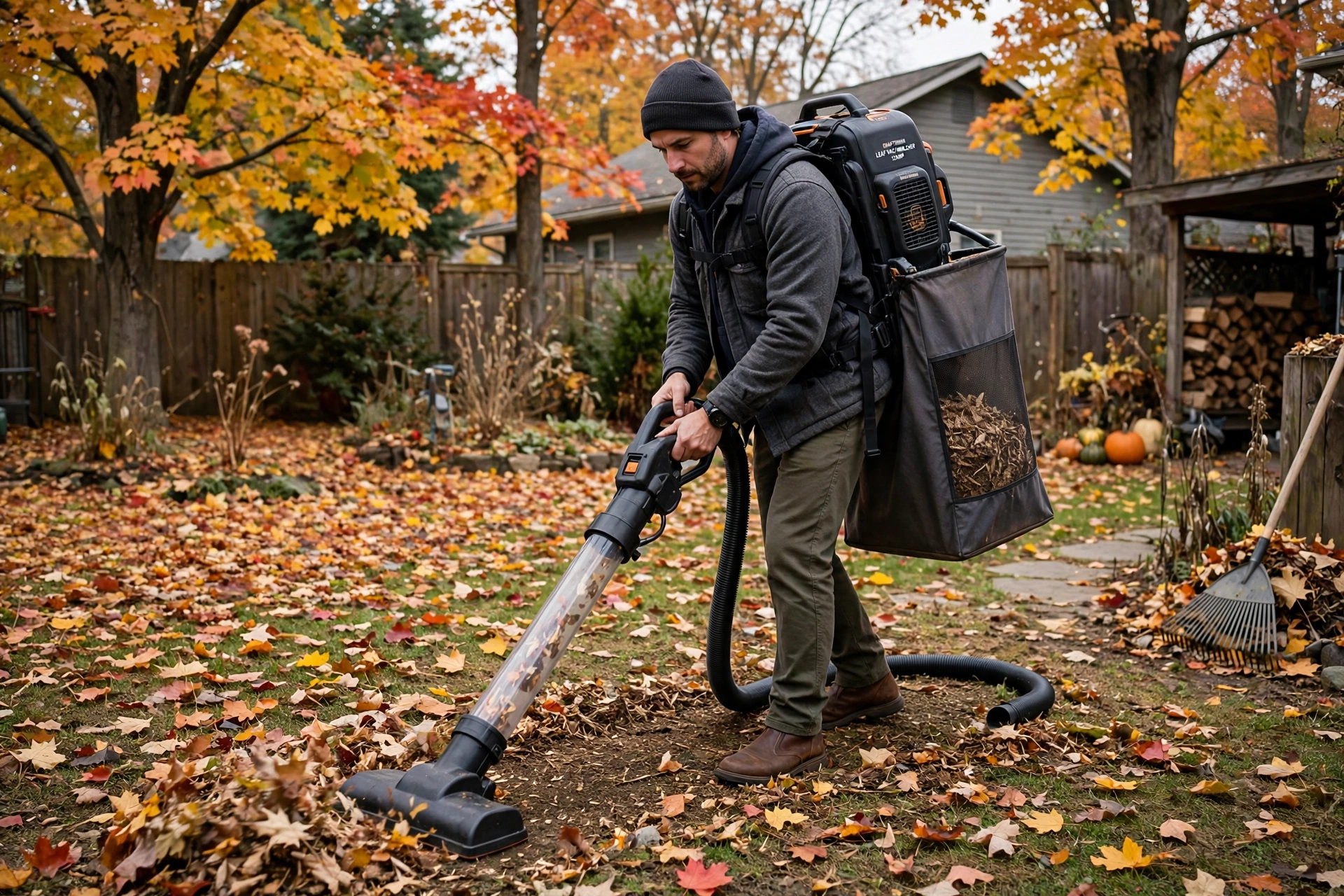
Best for bagging less: WORX WG583 3-in-1 blower/vacuum/mulcher
Blows the leaves into rows, then vacuums and shreds them into the bag at up to a 16:1 mulch ratio — that’s one bag where you’d have filled sixteen. If bagging is your least favorite part of fall, this is the tool that fixes it.
→ Click here to check price on Amazon
The $35 upgrade everyone skips: a leaf hauler tarp
Bagging by hand is the slowest, worst part of the job. Rake onto a hauler tarp (the popular ones are 6×4 ft with stakes and handles, ~$35), drag the whole pile to the curb or compost at once. Reviewers consistently say it’s the single biggest time saver in the yard.
→ Click here to check price on Amazon
5 mistakes that make leaf season miserable
- Waiting for every leaf to fall. Do two passes — one now, one after the last drop. Wet, matted November leaves are 3x the work of dry October ones.
- Blowing against the wind. Obvious, universally ignored. Start downwind and work with it.
- Buying CFM you don’t need (or do). Undersized blowers on big yards mean double the passes; oversized blowers on small patios just blast mulch out of the beds. Match the tool to the lot.
- Bagging whole leaves. Shredded leaves take 1/10th the bags. Mulch-mow them or run them through a vac/mulcher before bagging.
- Forgetting the gutters. Leaf cleanup that ignores the gutters buys you an ice dam in January. Blow them out or run a blower attachment while you’re out there.
FAQ
Should I rake leaves or leave them on the lawn?
A light layer, mulch-mowed in, feeds the lawn. A thick mat smothers it — smothered grass comes back patchy in spring. When in doubt, shred what you can and collect the rest.
When is the best time to clean up leaves?
Late October and again in late November in most zones — two passes. Doing it all in one late push means dealing with wet, frozen mats.
Are cordless blowers powerful enough, or do I need gas?
Modern 56–60V blowers (650–765 CFM) match handheld gas blowers for residential work. Gas only still wins for acre-plus properties and all-day commercial use — and many HOAs now restrict gas noise anyway.
What’s the fastest way to bag leaves?
Don’t bag by hand: rake onto a hauler tarp, or blow/shred into a vac/mulcher bag. Both cut bagging time dramatically versus scooping handfuls into bags.
What do I do with all the leaves?
Curbside yard-waste pickup if your city offers it, municipal compost drop-off, or your own compost pile — shredded leaves are premium compost “browns.” Never blow them into the street; most cities prohibit it and they clog storm drains.
Leave a Reply