Built & Backyard is reader-supported: we may earn a commission from qualifying purchases made through links on this page, at no extra cost to you.
The cooking gets all the attention, but Thanksgiving is won or lost in the hour after the meal. The same bird you timed so carefully with our turkey thaw guide has a hard deadline once it leaves the table, the gravy has the shortest clock of anything you made, and the freezer can either save you a week of easy dinners or produce a bag of frostbitten mystery meat you’ll throw out in February. This guide is the whole storage plan in one place: the fridge times that matter, the two-hour rule nobody should negotiate with, what freezes well and what honestly doesn’t, and a labeling system simple enough to actually use when you’re tired and the kitchen is a wreck. If the bird came out of an electric roaster oven or a turkey fryer, the rules below are identical — storage doesn’t care how it was cooked.
Quick answer
Get everything into the fridge within 2 hours of coming off the heat. Carve the turkey off the bone, store it in shallow containers, and eat it within 3–4 days. Gravy gets 1–2 days, mashed potatoes 3–5 days, stuffing 3–4 days, and pumpkin pie about 3–4 days in the fridge. Anything you won’t eat by Sunday goes in the freezer the day it’s cooked — turkey and gravy freeze well for 2–3 months at best quality. Label every container with what it is, the date it went in, and the date to use it by. Reheat everything to 165°F.
The 2-hour rule (and the shallow-container trick)
Bacteria multiply fastest between 40°F and 140°F, and cooked food sitting on a holiday table drifts into that zone while everyone is still talking. The USDA rule is simple:
- 2 hours, total, from the time food comes off the heat to the time it’s in the fridge — and that clock includes carving, serving, and the meal itself.
- 1 hour if the room is above 90°F (rare at Thanksgiving, but the rule is the rule).
- When in doubt, throw it out. Leftovers are cheap. Food poisoning is not, and you cannot smell or taste your way to safety.
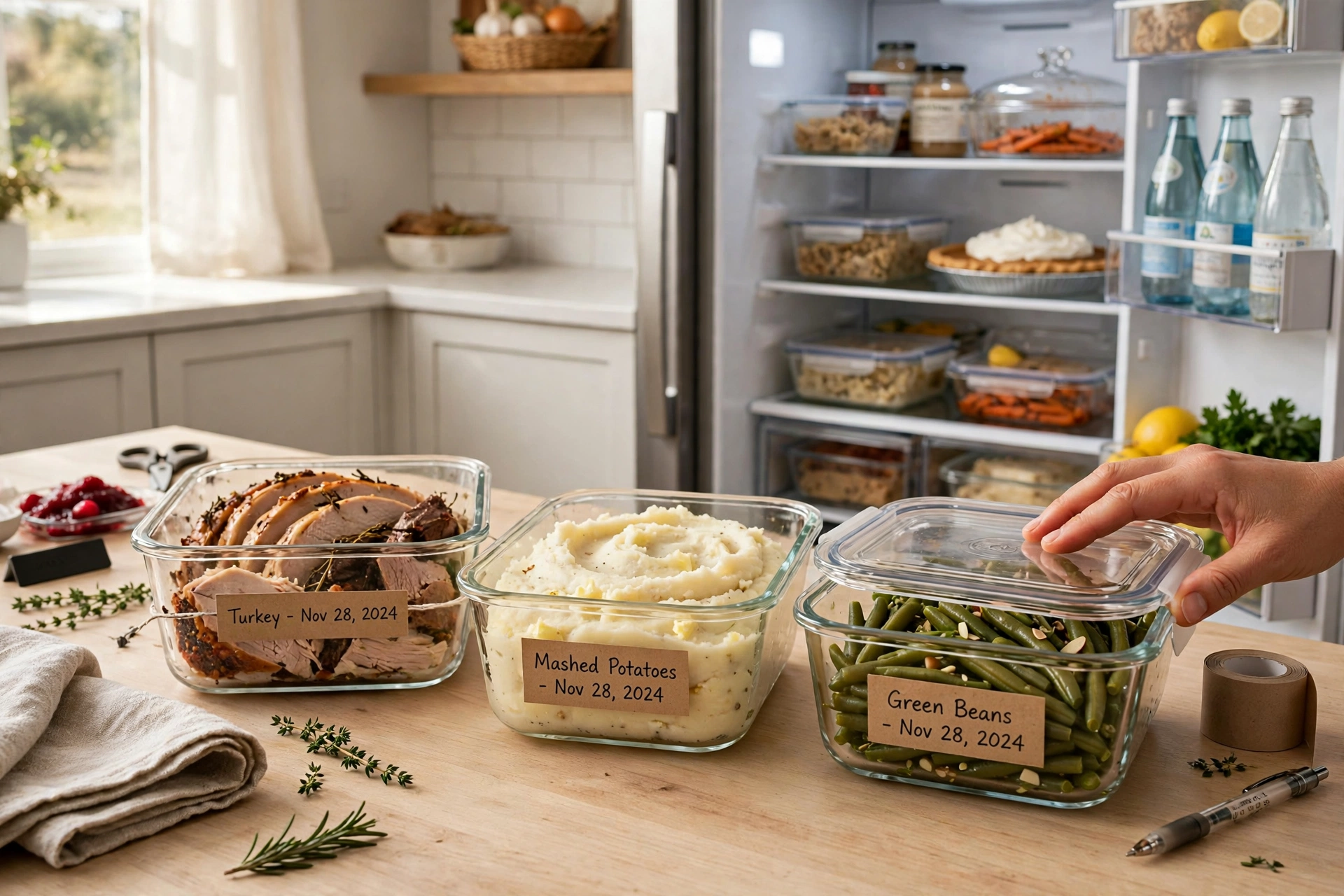
The second half of the rule is how the food goes in. A deep pot of hot stuffing can take hours for the center to cool to fridge temperature — hours spent in the danger zone even inside the refrigerator. Spread food in shallow containers, no more than about 2 inches deep, and it chills fast and evenly. Don’t stack hot containers tight together; leave a little air space the first night. And set your fridge to 40°F or below and the freezer to 0°F — most people have never checked, and holiday week is the wrong time to discover the fridge is running at 44°F.
Fridge times: how long each dish actually keeps
These are the standard USDA/FoodSafety.gov windows for cooked leftovers stored at 40°F or below. Count from the day it was cooked — Thanksgiving Day, Thursday, November 26, 2026.
- Turkey (carved, off the bone) — 3–4 days in the fridge (last good day: Sun Nov 29 – Mon Nov 30)
- Gravy — 1–2 days in the fridge (last good day: Fri Nov 27 – Sat Nov 28)
- Mashed potatoes — 3–5 days in the fridge (last good day: Sun Nov 29 – Tue Dec 1)
- Stuffing / dressing — 3–4 days in the fridge (last good day: Sun Nov 29 – Mon Nov 30)
- Cranberry sauce — 10–14 days in the fridge (last good day: the marathon runner of the table)
- Pumpkin pie — 3–4 days in the fridge (last good day: Sun Nov 29 – Mon Nov 30)
- Green bean casserole — 3–4 days in the fridge (last good day: Sun Nov 29 – Mon Nov 30)
Two notes worth knowing. Gravy has the shortest clock on the table — if you love it, freeze a portion Thursday night instead of hoping it makes the weekend. And pumpkin pie is a fridge food, not a counter food: it’s an egg-and-milk custard, and the two days it traditionally spends on the counter is exactly the habit this guide exists to break. Fruit pies (apple, pecan) are fine at room temperature for about 2 days.
Carve all the meat off the carcass before refrigerating — it chills faster, stores flatter, and takes a fraction of the space of a whole bird skeleton. Save the carcass itself in a freezer bag: that’s a free pot of turkey stock waiting for a December weekend.
The freezer plan: what freezes well, what doesn’t
Freezing doesn’t kill the clock forever, but at 0°F it stretches days into months. Best-quality windows (food stays safe beyond these, it just dries out and loses texture):
Freezes well:
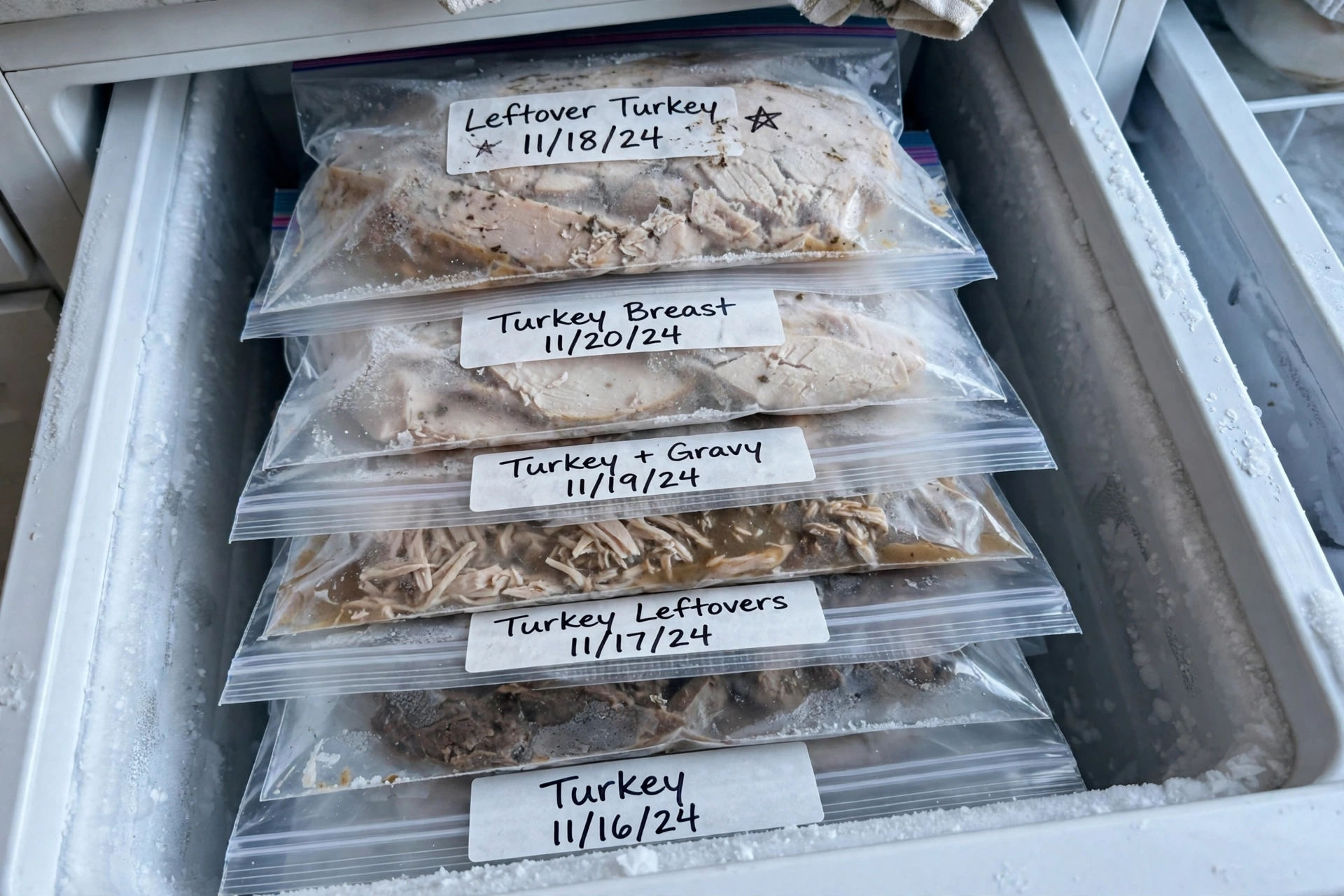
- Turkey meat — 2–3 months at best quality. Freeze it in meal-size portions with a spoonful of gravy or broth in the container to keep it moist.
- Gravy — about 2–3 months. It may separate when thawed; a whisk over gentle heat brings it back together.
- Mashed potatoes — 1–2 months, especially if they were made with butter and cream. The fat is what protects the texture.
- Stuffing — about 1 month. Reheat covered so it re-steams instead of drying out.
- Cranberry sauce — 2 months or more. It freezes so well there’s no excuse for wasting it.
- The carcass, for stock — whenever you’re ready.
Freezes poorly (eat these fresh instead):
- Green bean casserole — the honest verdict is meh: the beans go limp and the crispy onions never come back. Freeze it if you must, but expect a shadow of the original.
- Anything with a crispy topping — the crunch is a one-time event.
- Salads, deviled eggs, and cream-based dips — texture casualties, every one.
Freeze in the portions you’ll actually use. A gallon bag of turkey you have to thaw whole is a problem deferred, not a dinner saved — flat zip bags of a pound or so stack like files, thaw in a sink of cold water in about an hour, and pull out one at a time.
The labeling system that ends mystery containers
Every leftover failure in history has the same root cause: an unlabeled container and an optimistic guess. The fix takes ten seconds per container, at packing time, while you still know what everything is.
On a strip of painter’s tape or a freezer label, write three things:
- What it is — “Turkey, dark meat” beats “leftovers”
- The date it went in — “11/26”
- The use-by date — “Eat by 11/30” for the fridge, “Use by Feb” for the freezer
That’s the whole system. It works because it answers the only two questions anyone ever asks a container — what are you and are you still good — without opening it. Put the tape on the lid, not the side, so it’s readable in a stacked fridge. First in, first out: new containers go behind the older ones.
Reheating: 165°F, every time
- Reheat all leftovers to 165°F throughout — a thermometer reading in the thickest part, not a guess from bubbling edges.
- Gravy and soups: bring to a full rolling boil on the stove.
- Turkey: reheat in a 325°F oven with a splash of broth in a covered dish to keep it moist, or slice and warm it in gravy — the classic move, and the best one.
- Thaw frozen leftovers in the fridge overnight (or in cold water, changed every 30 minutes), never on the counter — that’s the same rule as the raw bird, and it doesn’t retire just because the food is cooked.
- Only reheat what you’ll eat. Each reheat cycle shortens the clock, and leftovers of leftovers are where the 3–4 day rule goes to die.
The gear that makes storage easy
Glass Storage Container Set with Locking Lids
Glass doesn’t stain, doesn’t hold last week’s onion smell, and goes from fridge to oven to table; the locking lids actually seal — which is the entire point — and the sizes nest instead of avalanching out of the cabinet.
→ Click here to check price on Amazon
Freezer-Safe Zip Bags, Gallon Size
Freeze turkey flat in these and the bags stack like books, thaw in half the time of a solid block, and squeeze the air out by hand for a seal that holds up for months.
→ Click here to check price on Amazon
Vacuum Sealer
The upgrade that turns a 2–3 month freezer window into 6 months or more — air is what freezer burn is, and this removes the air. Worth it if you freeze in bulk more than twice a year.
→ Click here to check price on Amazon
Label Maker (or freezer labels and a marker)
Ten seconds per container — what it is, when it went in, when to use it by — printed clean enough to read through frost, which is how the mystery-container problem actually ends.
→ Click here to check price on Amazon
Fridge & Freezer Thermometers (2-pack)
One for the fridge, one for the freezer — because the whole plan above runs on 40°F and 0°F, and most dials in most kitchens are lying to you.
→ Click here to check price on Amazon
(Already on our Recommended Gear hub in the Winter power outage prep section — listed once there on purpose.)
The short version
Two hours to the fridge, shallow containers, carved off the bone. Turkey by Monday, gravy by Saturday — or freeze portions of both on Thursday night and take the pressure off entirely. Label everything with what, when, and use-by. Reheat to 165°F. Do those five things and Thanksgiving feeds you twice: once at the table, and again all weekend, safely.
Leave a Reply