Disclosure: This post contains affiliate links. If you buy through them, Built & Backyard may earn a commission at no extra cost to you.
Quick answer
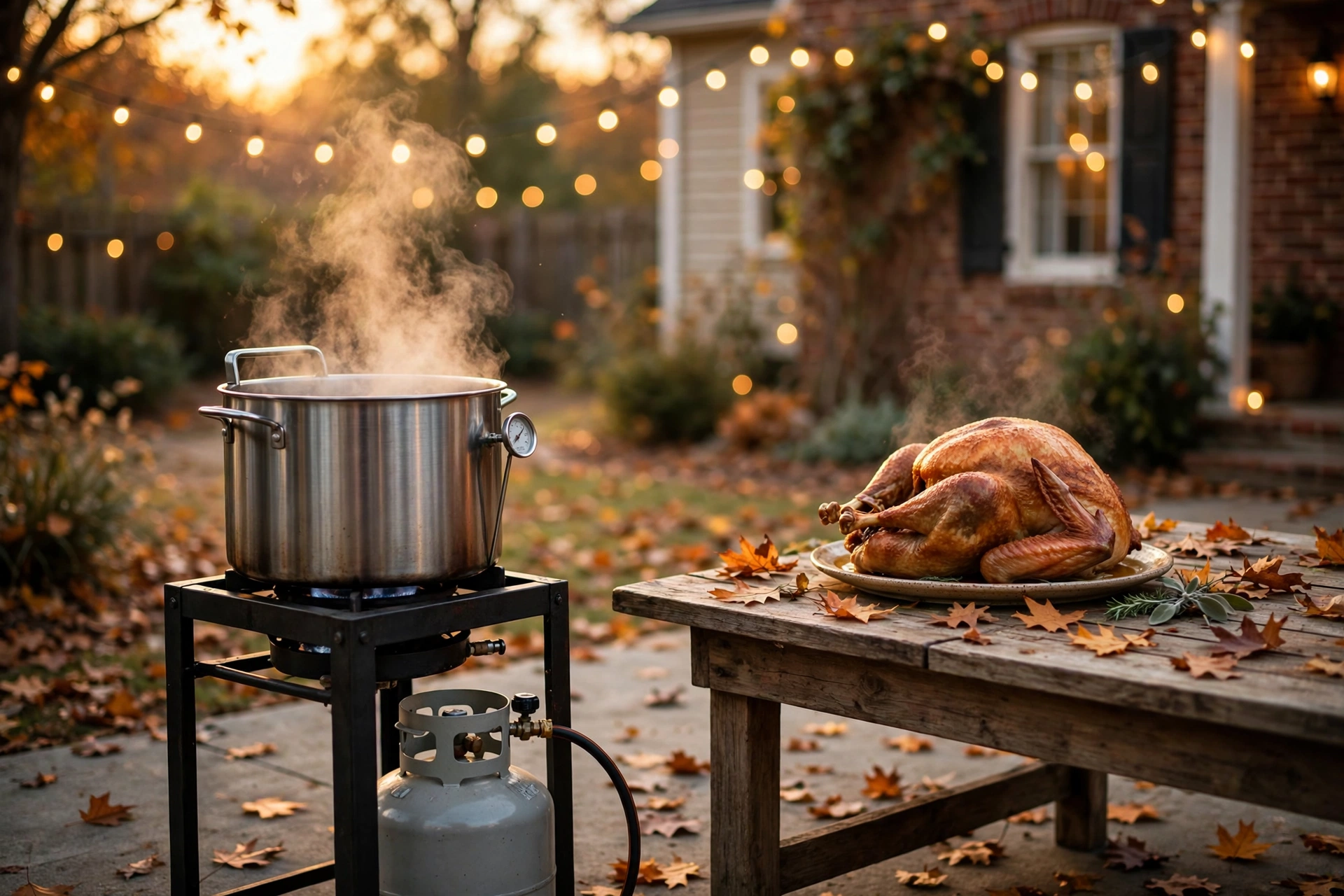
For most families, a 30-quart propane turkey fryer kit and a 12–16 pound bird is the sweet spot. A 30-quart pot is the standard minimum for a whole turkey; birds up to about 20 pounds are the practical ceiling, and smaller birds in the 12–16 pound range fry more evenly and are far more forgiving on oil level. Plan on roughly 3–5 gallons of peanut oil, heat it to 375°F before the bird goes in, and fry at about 3½ minutes per pound, checking for 165°F in the thigh and breast. And the part that is not optional: fry outdoors, on flat concrete or dirt, well away from the house — never in a garage, never on a wooden deck, and never with a bird that isn’t completely thawed and dried.
Fried turkey is a Southern Thanksgiving institution for a reason — an hour in the pot instead of five hours in the oven, and skin no oven bird ever matched. It pairs with our outdoor TV setup guide — the fryer crew is outside for an hour either way, so give them the game — and it’s the main event the holiday gatherings in our outdoor Christmas light setup are warming up for.
Step 1: Match the pot to the bird
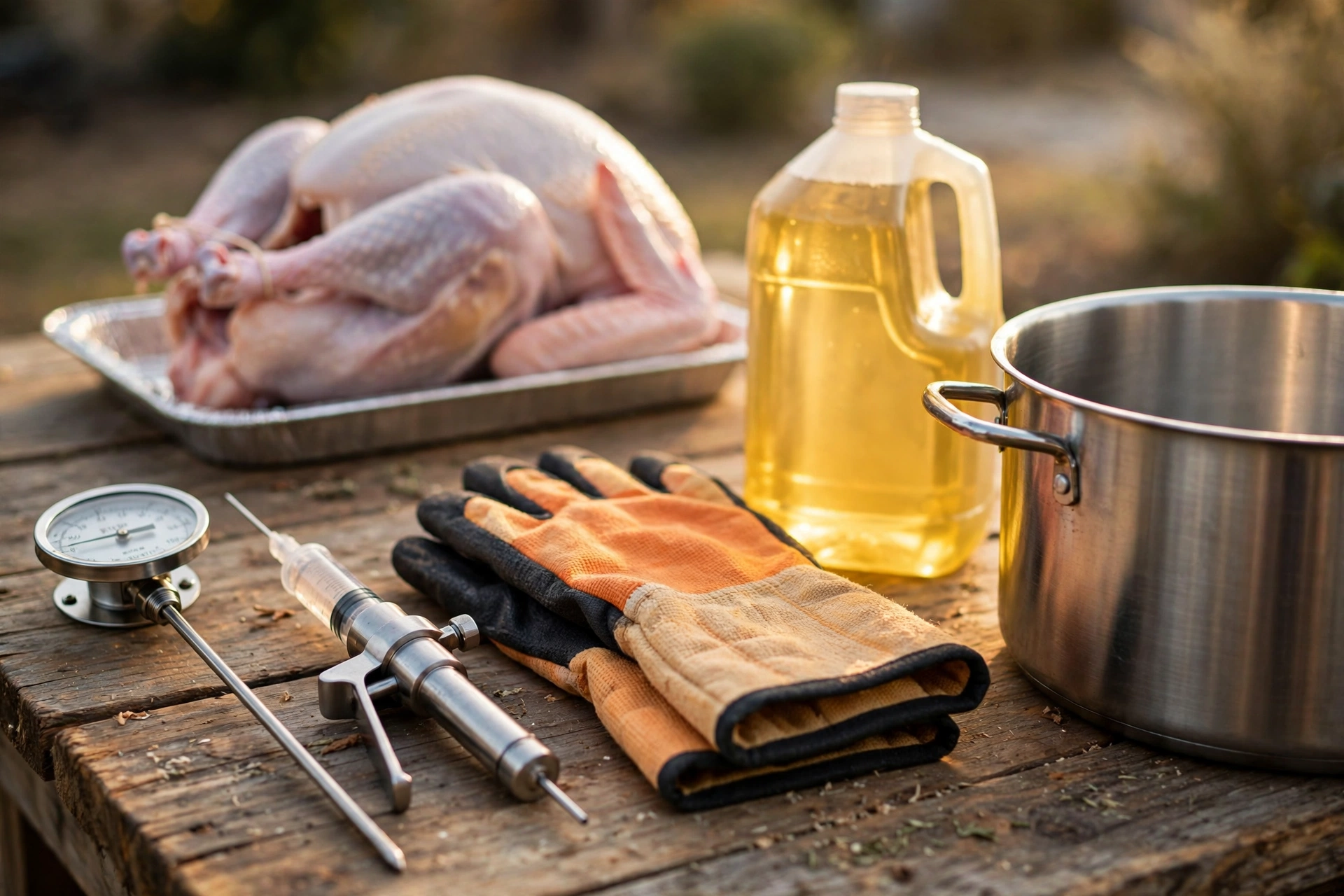
- 30-quart pot: the standard kit size. Comfortable with a 12–16 pound turkey; can handle up to roughly 20 pounds if you are careful with the oil level (Step 2 is what makes that safe).
- Bigger birds (20 lb+): two smaller birds beat one giant one. They fry more evenly, cook faster, and you get two drumstick sets for the family argument. If you truly need one big bird, step up a pot size rather than crowding a 30-quart.
- Turkey breast only (7–9 lb): a smaller pot works, and the fry time runs longer per pound — about 7 minutes per pound at a lower temperature in most electric fryer manuals. Check your model’s numbers.
- The burner matters too. A kit burner with an adjustable regulator and a sturdy, wide stand is worth more than raw BTU bragging. The pot has to sit dead level and rock-solid — you are holding gallons of 350°F oil.
Step 2: The water-displacement test (do this days ahead)
This is the step that prevents the famous overflow fire, and it takes five minutes with water instead of oil:
- Put the thawed, raw turkey (still in its wrapper is fine for the test) in the empty pot.
- Add water until it just covers the bird.
- Pull the bird out and note the water line — mark it. That line is your maximum oil fill line. Most cooks need roughly 3–5 gallons of oil, but the line, not the jug count, is the truth.
- Dump the water, and dry the pot and the bird completely before fry day.
Too much oil is the #1 cause of fryer fires: the bird displaces oil, the pot boils over onto an open flame, and the afternoon is ruined in the worst way. The test removes all guessing.
Step 3: The thaw clock runs the schedule
A frozen turkey and hot oil are the most dangerous combination in outdoor cooking — ice flashes to steam and erupts the oil. There are no shortcuts here:
- Fridge thawing: about 24 hours for every 4–5 pounds. A 16-pound bird needs roughly 3–4 days. Count backwards from Thanksgiving: a 16-pounder bought frozen should be in the fridge by the Sunday before.
- Cold-water thawing (the backup plan): about 30 minutes per pound, water changed every 30 minutes.
- Before frying: remove the neck and giblets, pat the bird completely dry inside and out, and let it sit out just long enough to take the deep chill off while the oil heats. Dry bird, safe fry — moisture on the skin is what makes the oil spatter and surge.
Step 4: Fry day, in order
- Set up outside on level concrete or dirt, well away from the house, garage, eaves, and any wooden deck. Keep kids and pets inside the line you set. Have a dry-chemical fire extinguisher within reach — and never, ever plan on water for a grease fire.
- Fill oil only to your marked line from Step 2. Peanut oil is the Louisiana favorite for its high smoke point (around 450°F) and clean flavor; canola is the common substitute.
- Heat to 375°F with a long-stem thermometer clipped to the pot. Heating takes roughly 30–45 minutes — this is not a leave-it-alone job at any point.
- Turn the burner off (the pro move most guides skip), hook the bird, and lower it very slowly into the oil — an inch at a time over a full minute or more. Relight the burner once it’s in. Slow lowering is what keeps the surge from boiling over.
- Hold the temperature: about 350°F for birds in the 10–13 pound range, closer to 325°F for 14–20 pounders so the skin doesn’t outrun the middle.
- Time it at ~3½ minutes per pound, then verify: 165°F in the thickest part of the thigh and the breast, checked with an instant-read thermometer after you lift the bird out and let it drain.
- Rest 20–30 minutes before carving. Let the oil cool completely — hours — before moving the pot or filtering the oil for reuse.
The fryer checklist
- 30-quart kit minimum; bird 12–16 lb for the easy version.
- Water-displacement test done, fill line marked, days ahead.
- Bird thawed on the 24-hours-per-4–5-pounds clock and dried completely.
- Fryer on flat concrete/dirt, outdoors, away from structures and decks.
- Extinguisher in reach, kids and pets back, burner off during the slow lower.
- 375°F start, ~3½ min/lb, 165°F verified — never trust the timer alone.
Get those right and fried turkey stops being a dare and becomes the family tradition it is across the South. And if your holiday hosting runs past dark and into the cold, the guides collected on our Recommended Gear page cover the heaters, lights, and patio gear that keep the gathering outside.
Picks for the job
30-quart propane turkey fryer kit with burner and stand
The standard kit: pot, lifting hook, thermometer, and a sturdy burner stand. This is the size the math above assumes.
→ Click here to check price on Amazon
Peanut oil, 3-gallon
The classic frying oil — high smoke point, clean flavor, and enough for a standard 30-quart fry with the fill line respected.
→ Click here to check price on Amazon
Instant-read meat thermometer
The timer gets you close; this decides. Fast reads in the thigh and breast are how you know it’s 165°F and done.
→ Click here to check price on Amazon
Marinade injector kit, stainless
Cajun butter injection is half the reason to fry a turkey. A stainless injector with multiple needles survives more than one season, unlike the plastic freebies.
→ Click here to check price on Amazon
Heat-resistant fryer gloves
For handling the hook, the pot handles, and everything else that sat next to 350°F oil. Silicone-lined, forearm-length is the version you want.
→ Click here to check price on Amazon
Mistakes that ruin Thanksgiving (or worse)
- Frying a partially frozen bird. The single most dangerous mistake on this list. Thaw it fully, on the clock in Step 3, or roast it instead.
- Skipping the water test and eyeballing the oil. Overflow onto an open flame is how fryer fires start. Five minutes with water removes the guess.
- Frying in the garage or on the deck “because it’s raining.” Open flame plus gallons of hot oil belongs outdoors on a non-combustible surface, full stop. (Garages are for the heaters actually rated for them — a different guide entirely.)
- Dropping the bird in fast. Lower it over a minute or more, burner off. The surge is physics; rushing it is a choice.
- Leaving the fryer unattended. Oil heating, bird frying, oil cooling — an adult is on station for all of it.
Leave a Reply