Disclosure: This post contains affiliate links. If you buy through them, Built & Backyard may earn a commission at no extra cost to you.
Quick answer
Fall winterizer is the single most important lawn fertilizer application of the year. One late-fall feeding — high nitrogen, slow-release, applied when top growth stops but roots are still active — fuels root storage all winter and delivers noticeably thicker, greener spring growth. The window: after your last mow, before the ground freezes. In the northern zones that’s roughly late October through mid-November; southern zones run later. One bag on a typical suburban lawn costs less than a pizza and does more for your yard than all summer feeding combined.
What winterizer actually is
Regular lawn fertilizer balances the three numbers (N-P-K). Winterizer skews hard toward nitrogen — look for ratios like 32-0-10 or 30-0-10 — because nitrogen is what the grass converts into stored carbohydrates in its roots before dormancy. The phosphorus and potassium get de-emphasized; most established lawns have plenty of P already, and you’re not building top growth at this point.
Two things to demand on the bag:
- Slow-release nitrogen (look for “water-insoluble nitrogen,” WIN, or polymer-coated urea). It meters the nitrogen out over 6–8 weeks instead of dumping it all at once — longer root feeding, less burn risk.
- A spreader-friendly granule size. If you’ve ever fertilized with dust, you know why this matters. Uniform prills = uniform coverage.
When to apply: read the grass, not the calendar
The right time is when top growth stops — you haven’t mowed in about a week — but the grass is still green. The roots are still working even though the blades have quit, and that’s exactly who you’re feeding. Apply too early and the nitrogen just grows more top you then have to mow off; too late (frozen ground) and the granules sit on top and wash away in spring melt.
The practical window:
- Northern zones: roughly late October to mid-November — you’re in it right now
- Transition zones: through November
- Southern zones (warm-season grass): winterizer matters less; overseeded rye lawns get fed, dormant bermuda doesn’t
The mow-first rule: cut the grass short-ish (2.5–3″) one last time before you apply. Granules sitting on tall grass wash or blow off; granules on a short lawn fall to the soil and stay put.
Our picks
Best overall winterizer: Scotts Turf Builder WinterGuard (32-0-10)
The category default for a reason: high nitrogen, slow-release, and the EdgeGuard-style spreader compatibility every yard already knows. A 12.5-lb bag covers 5,000 sq ft — one bag does most suburban lawns.
→ Click here to check price on Amazon
The organic option: Milorganite (6-4-0)
Won’t burn anything, feeds the soil biology too, and the slow-release iron gives a nice color response. The trade-off: you need roughly 4x the product to match the nitrogen of a synthetic winterizer, so it’s pricier per lawn on big yards. Great choice for small lots and anyone burned (literally) by fertilizer before.
→ Click here to check price on Amazon
Don’t guess: MySoil test kit
One winterizer application applied to soil that’s wildly off on pH is half wasted. A $30 mail-in test tells you pH, nutrients, and exactly what your lawn is missing — buy it once, use the results for years.
→ Click here to check price on Amazon
The spreader it deserves: Scotts EdgeGuard Mini broadcast spreader
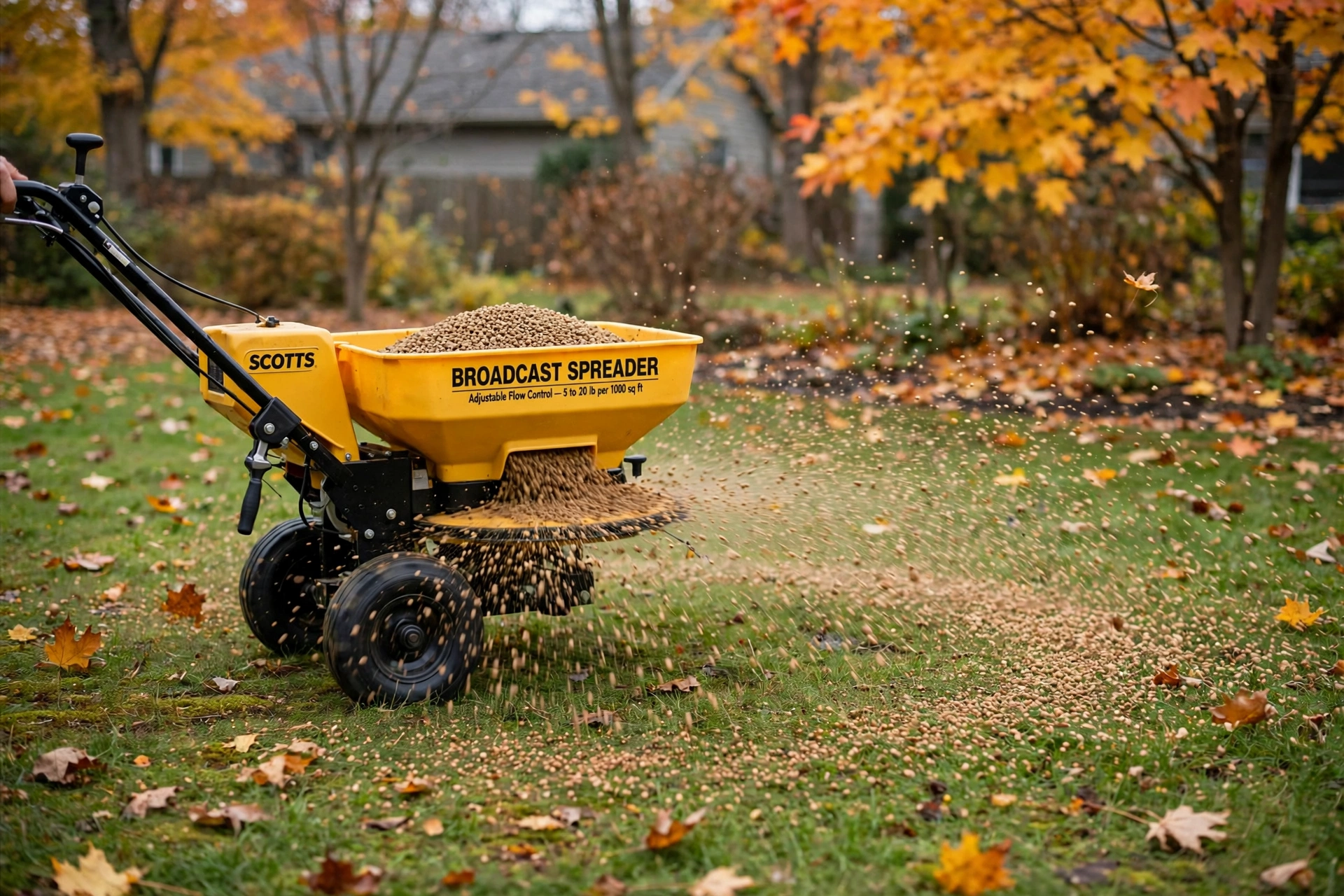
The most common spreading error is uneven coverage. A calibrated broadcast spreader with edge control keeps granules off the driveway and sidewalk. Whatever spreader you own, walk at a steady pace and overlap your passes slightly — stripes in spring are the signature of a rushed fall application.
→ Click here to check price on Amazon
How to apply it right (the 5-minute version)
- Mow short (2.5–3″) and clear heavy leaf cover first — granules need to reach soil.
- Calibrate your spreader. Start at the bag’s recommended setting; you can always make a second light pass, but you can’t un-spread a double-rate pass.
- Walk the perimeter twice (with edge guard on) to build a buffer, then fill in the middle in straight, slightly overlapping lines.
- Water it in if rain isn’t coming within 24–48 hours. A quarter inch of water settles granules into the turf and starts them working.
- Sweep the hard surfaces. Granules on the driveway stain concrete and wash into storm drains — broom them back onto the lawn.
5 mistakes that waste your winterizer
- Applying too early. Feeding while the grass is still growing vigorously pushes soft top growth that’s vulnerable to winter disease. Wait for the growth to stop.
- Applying to frozen ground. Granules bounce and migrate. If the ground has crusted over, you’ve missed the window — save the bag for spring (it won’t go bad).
- Skipping the last mow. Tall grass catches granules and they never reach soil. Short lawn = good contact.
- Doubling the rate “for a thicker lawn.” Excess nitrogen in fall can cause snow mold and leaching. More is not better — the bag rate is the rate.
- Forgetting the leaf cleanup first. A mat of wet leaves between your fertilizer and the soil means the nutrients feed the leaves, not the lawn. Clear it (or mulch-mow it — see our leaf cleanup gear guide for the fast way).
FAQ
Can I use regular fertilizer instead of winterizer?
You can, but you’re leaving results on the table. Summer fertilizers are balanced for growth; winterizer’s high-nitrogen, slow-release formula is specifically designed for root storage before dormancy. The one application where the specialty bag earns its premium is this one.
Is winterizer worth it on a mediocre lawn?
Honestly, it’s worth it most on a mediocre lawn. A healthy lawn can coast; a thin lawn benefits enormously from the spring head start. The exception: lawns so weedy or damaged they need renovation — fertilizer won’t fix dead spots, overseeding and soil work will.
Do I need to fertilize at all in fall if I fertilized in summer?
Yes — they’re doing different jobs. Summer feed builds top growth; winterizer builds root reserves. Skip summer and most lawns forgive you; skip winterizer and you see it in April.
When will I see results?
Not this year — that’s the point. The payoff lands in spring: earlier green-up, thicker growth, and a lawn that out-competes weeds on its own. Patience is the entire product.
Leave a Reply