Disclosure: This post contains affiliate links. If you buy through them, Built & Backyard may earn a commission at no extra cost to you.
Quick answer
Winterizing a mower takes about 30 minutes and saves you a spring trip to the repair shop. Run the engine dry or stabilize the fuel, change the oil, clean the deck, and either pull the battery or put it on a maintainer. Do it before the last mow of the season — not in January, when the gas has already gone stale.
The number-one reason mowers won’t start in spring is old gasoline. Ethanol fuel starts breaking down in as little as 30 days, and by spring it has gummed up the carburetor. Everything else on this list is cheap insurance; the fuel step is the one that actually decides whether it starts.
Step 1: Deal with the fuel — the step that matters most
You have two good options. Pick one, and actually do it:
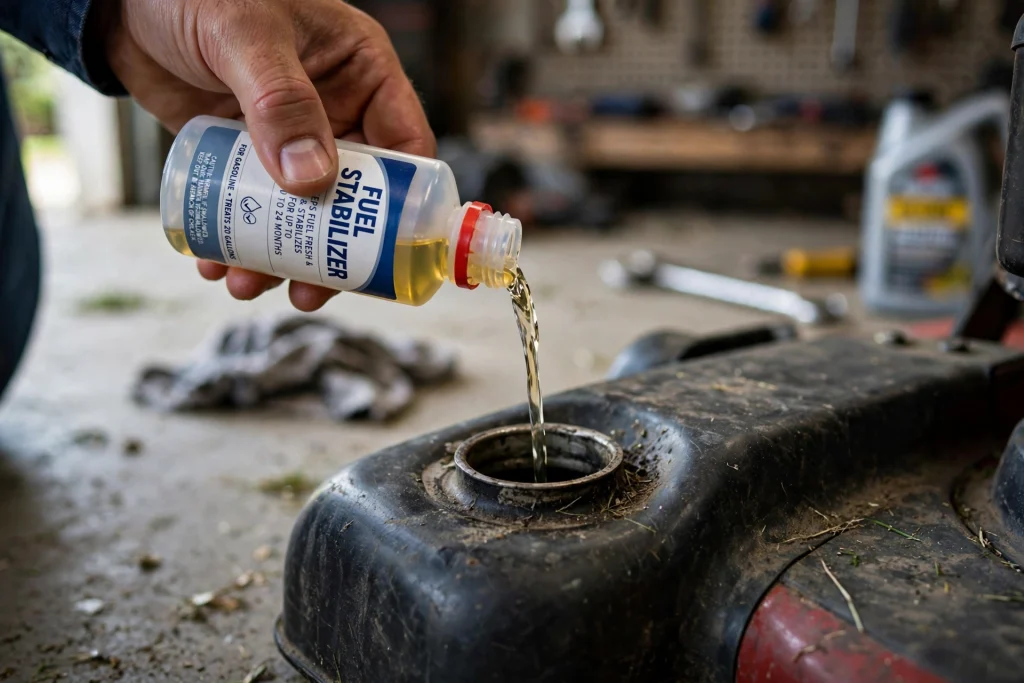
Option A — Stabilize it. Pour fuel stabilizer into a full tank, run the engine for 5–10 minutes so treated fuel reaches the carburetor, and shut it off. A full tank also leaves less air (and moisture) inside. This is the easiest option, and it’s the right one if you might still need the mower for a late leaf cleanup — see our leaf cleanup gear guide.
Option B — Run it dry. If you won’t touch the mower for 4+ months, run the tank empty, then run the engine until it stalls on its own. No fuel left means nothing to go stale. Just know that a dry carburetor can make the first spring start a little crankier — prime it well.
What not to do: park it in November with a half tank of untreated gas and hope for the best. That is exactly how a $15 problem becomes a $120 carburetor cleaning.
Step 2: Change the oil (yes, now, not in spring)
Old oil holds combustion acids and moisture all winter, sitting against bearings and seals. Warm the engine for a few minutes, drain it, and refill with fresh oil to the mark on the dipstick. It takes ten minutes, and your mower wakes up in spring with clean oil already in it instead of last season’s sludge.
While you’re at it: pull the air filter and tap it out or replace it if it’s grey and clogged, and check the spark plug. A fouled plug is a $5 spring headache you can prevent in fall.
Step 3: Clean the deck and sharpen (or at least inspect) the blade
Scrape dried grass off the underside of the deck — a putty knife and a stiff brush do it. Packed-on clippings trap moisture and rust the deck over winter. Hose it down, let it dry fully, and spray a light coat of silicone or WD-40 underneath if you want to slow rust.
Check the blade while you’re under there. If it’s nicked or dull, this is the time to sharpen it or swap it — not the Saturday in April when the grass is already a foot tall.
Step 4: The battery (riding mowers and electric starts)
Remove the battery, clean the terminals, and store it somewhere cool and dry — not on a freezing garage floor. Better yet, hook it to a battery maintainer for the winter. A maintainer is not a trickle charger: it tops the battery up only when needed, so it won’t cook it over four months. A dead spring battery is the second-most-common “it won’t start” call, right behind bad gas.
Push mowers with no battery: skip this step. You just saved yourself five minutes.
Step 5: Store it right
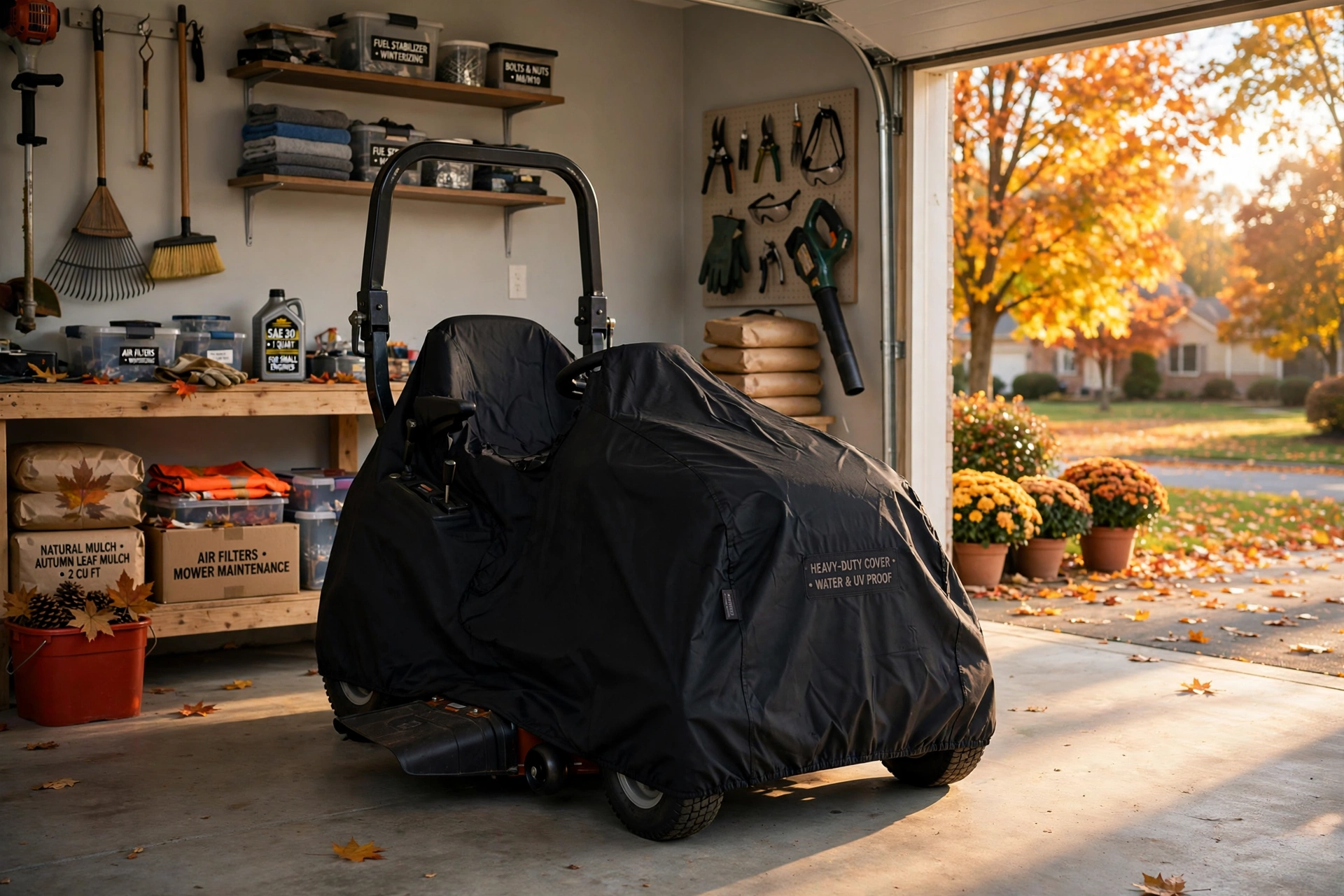
- Store it level, in a dry spot. A shed or garage beats a tarp in the yard. If it has to live outside, a fitted cover beats a loose tarp, which traps moisture.
- Don’t tip it the wrong way. If you need to tilt a mower, keep the carburetor and air filter up, or you’ll flood the filter with oil. When in doubt, check the manual.
- Fold the handle if yours folds — it frees up a surprising amount of garage space, which matters once the snow blower moves in for winter.
- Lock it up. Mowers walk out of open garages more than people admit. A cable through the handle and a fixed point is cheap peace of mind.
The 30-minute winterizing checklist
- Add stabilizer to a full tank and run 5–10 minutes — or run the tank dry.
- Warm up, drain, and refill the oil.
- Clean or replace the air filter; check the spark plug.
- Scrape and dry the deck; inspect the blade.
- Remove the battery (riding mowers) and put it on a maintainer.
- Store level, dry, and covered.
Do this once, and spring’s first mow is a pull-and-go instead of a diagnostic session. It pairs naturally with the rest of fall yard shutdown: our fall lawn winterizer guide covers the last fertilizer application, and if you’re storing gas cans for winter, the fuel advice in our generator guide — propane stores forever, gasoline doesn’t — applies to your mower cans too.
Picks for the job
Fuel stabilizer: STA-BIL Storage
The one bottle that prevents the most common spring failure. Treat the last tank of the season and you’re done.
→ Click here to check price on Amazon
Fitted mower cover
Keeps dust, moisture, and garage grime off all winter — and it’s sized to the mower, so it doesn’t blow off or trap a puddle.
→ Click here to check price on Amazon
Battery maintainer: Battery Tender Junior
For riding mowers and electric-start models. Maintains the battery all winter without overcharging it.
→ Click here to check price on Amazon
Tune-up kit: oil, spark plug, and air filter in one box
One purchase covers steps 2 and 3 for most common push and riding mowers — check your model number before ordering.
→ Click here to check price on Amazon
Mistakes that cost you in spring
- Leaving untreated gas in the tank. The classic. Stabilize it or drain it.
- Skipping the oil change because “I’ll do it in spring.” Spring-you is busy, and old oil sits all winter.
- Storing it dirty. Wet grass on the deck all winter is a rust invitation.
- Leaving the battery in a freezing garage, unmaintained. Four months of cold and self-discharge kills marginal batteries.
- Tipping it carburetor-down. Oil in the air filter makes for a smoky, hard-starting spring.
Leave a Reply