Built & Backyard is reader-supported: we may earn a commission from qualifying purchases made through links on this page, at no extra cost to you.
Every homeowner eventually has the same thought, usually while standing on a kitchen chair or the second-from-top step of a wobbly bargain ladder: I should own a ladder that doesn’t scare me. Falls from ladders send a steady stream of people to emergency rooms every year, and most of those falls happen at home, on ladders that were too short, too light for the load, or one rung past their comfort zone. The fix isn’t a garage full of ladders. Two ladders, chosen well, cover nearly everything: a solid step ladder for the inside and the low outside jobs, and an extension ladder tall enough to reach your gutters and second-story eaves with room to spare. Here’s how to size both, what the duty ratings really mean, and which material is worth your money.
Quick answer
Buy two ladders. First, a 6 ft fiberglass step ladder rated Type I (250 lb) or Type IA (300 lb) — it covers ceiling work, painting, bulb and filter changes, and most one-story outdoor jobs, and fiberglass won’t conduct electricity if you brush a wire. Second, an extension ladder sized by this rule: its extended working length should reach about 3 ft above the edge you’re climbing onto, so for gutters at 16–18 ft you want a 24 ft extension ladder. Match the duty rating to you plus your tools, not just you — a 200 lb person carrying a 30 lb load needs a 250 lb rating minimum. And never stand on the top cap or the top two rungs of either ladder; if the job puts you there, the ladder is too short.
The two numbers that decide everything
Reach height, not ladder height. A ladder’s advertised size is its length, not how high you can work. The rule of thumb: a person of average height can safely reach about 4 ft above the highest rung they should stand on. On a step ladder, that’s roughly the ladder’s height plus 2–3 ft of comfortable work height — a 6 ft step ladder puts most adults working at 9–10 ft, which covers 8 ft ceilings, most painting, and single-story trim. On an extension ladder, you lose about 4 ft to the overlap and the 3 ft you keep above the roof edge, so a “24 ft” ladder gives you a working reach of around 20 ft.
Duty rating is you plus everything you’re carrying. The ratings are standardized: Type III (200 lb, light household), Type II (225 lb), Type I (250 lb, heavy duty), Type IA (300 lb, extra heavy duty), Type IAA (375 lb). Count your weight, your clothes, your tool belt, and whatever you’re hauling up — a gallon of paint is 10 lb, a bundle of shingles is far more. For most homeowners, Type I is the floor and Type IA is the comfort zone. A ladder that flexes and complains under you is telling you something; listen before you’re three rungs up.
Fiberglass or aluminum?
- Fiberglass — heavier and costs more, but it’s the safer default for homeowners: it doesn’t conduct electricity, it doesn’t dent, and it shrugs off weather if it lives in the garage or on a wall outside. If there’s any chance you’ll work near service drops, outlets or fixtures, this is the one.
- Aluminum — lighter and cheaper, and fine for purely mechanical work away from power. It conducts electricity, which is why pros near wires won’t touch it. The weight difference matters most on long extension ladders you’ll move alone.
- Wood — mostly a legacy choice now: heavy, weather-sensitive, and rarely the best value in either role.
For the step ladder, fiberglass wins outright. For a long extension ladder you’ll haul around the house solo, aluminum’s weight saving is a fair trade if your work stays clear of the service drop — but price the fiberglass version before you decide.
The picks
Little Giant Ladder Systems multi-position ladder — The one-ladder answer for uneven ground: it converts between step ladder, extension, staircase and 90-degree wall positions, which makes it the rare ladder that handles a stairwell paint job and a gutter run in the same afternoon. It’s heavier than a plain step ladder, and that’s the honest trade — in exchange you stop borrowing ladders for the weird jobs.
→ Click here to check price on Amazon
Werner 6 ft fiberglass step ladder (Type IA) — The default inside-and-out step ladder: fiberglass rails, a 300 lb Type IA rating, a molded top with slots for paint cans, brushes and tools, and slip-resistant steps. Six feet is the size that lives in the house without a fight — it fits a closet or a garage wall and still puts you at working height for ceilings, cabinets, filters and smoke detectors.
→ Click here to check price on Amazon
Werner 24 ft fiberglass extension ladder (Type IA) — The gutter and second-story pick: 300 lb rating, fiberglass rails for electrical safety, and enough length to reach typical two-story eaves with the required 3 ft to spare above the edge. The rungs are D-shaped so your feet sit flat instead of balancing on a round bar — a small thing that matters a lot at minute twenty.
→ Click here to check price on Amazon
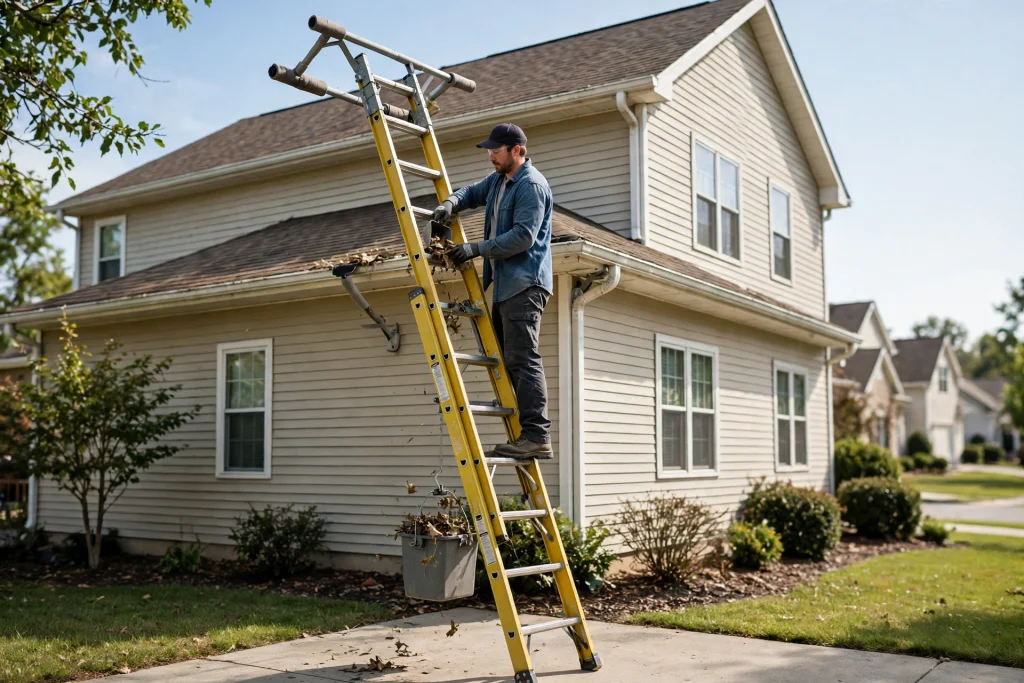
Ladder stabilizer / standoff bar — The accessory that changes gutter work completely: a wide bar that bolts to the top of the extension ladder, holds it off the wall and gutter face, and spreads the contact across two solid points instead of one wobbly one. You stop crushing gutters, the ladder stops wanting to slide sideways, and you gain a few inches of working room. Cheapest safety upgrade on this page.
→ Click here to check price on Amazon
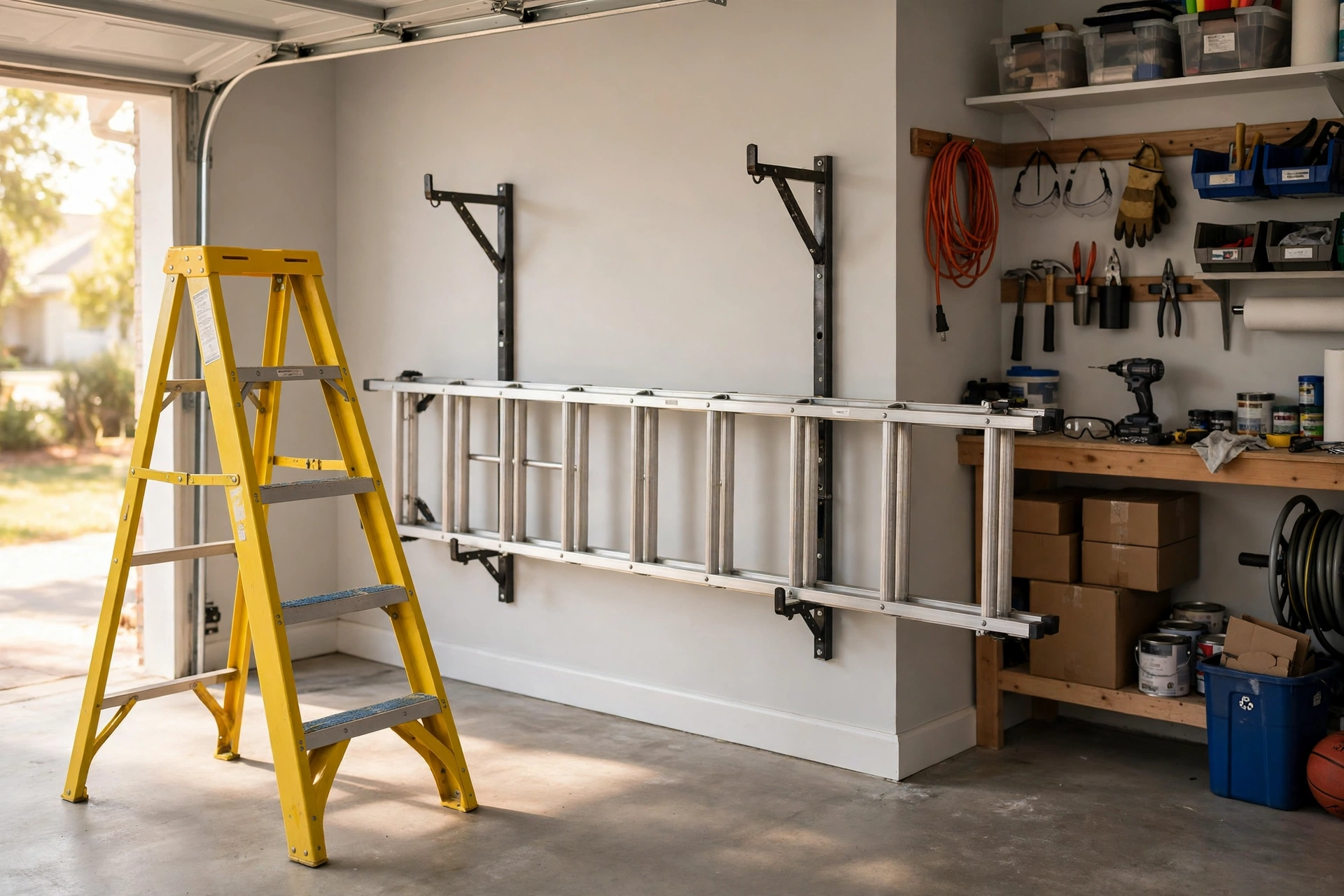
Wall-mounted ladder storage hooks — Ladders stored leaning in a corner get tripped over, knocked onto cars, and weathered. A pair of heavy-duty wall hooks or a rack gets both ladders flat against the garage wall, off the floor, and grabbable in ten seconds — which also means you’ll actually put them back. Rate the hooks for the extension ladder’s full weight and anchor them into studs, never drywall alone.
→ Click here to check price on Amazon
Use them right: the five rules that prevent the fall
- Four-to-one angle on the extension ladder. For every 4 ft of height, the base sits 1 ft out from the wall. Too steep and it tips back; too shallow and the base slides out.
- Three points of contact, always. Two hands and a foot, or two feet and a hand, on the ladder at all times. Carry tools in a belt or haul them up on a rope after you’re set — never in your hands on the climb.
- Face the ladder and stay centered. Belt buckle between the rails. The moment you’re leaning out to reach, climb down and move the ladder; overreaching is how most home falls happen.
- Level ground or don’t climb. Set up on firm, flat footing. A ladder leg on soft soil or a slope needs a leveler or a different spot — never a brick, a block, or a “probably fine.”
- Inspect before every use. Check rails for cracks, rungs for bends, feet for worn pads, and the extension ladder’s locks and rope. A damaged ladder gets retired, not repaired with tape and optimism.
Buy the two ladders once, buy them a rating above your weight, store them on the wall, and the chair-standing era of your home maintenance life is over.
Leave a Reply