
Built & Backyard is reader-supported: we may earn a commission from qualifying purchases made through links on this page, at no extra cost to you.
Fall drops two things on a Southern roof: leaves, and then the rain that turns those leaves into a dam. A clogged gutter doesn’t just spill over — it sends water down the siding, into the soffit, and pooling at the foundation, exactly where you don’t want it heading into winter. One dry weekend morning with the right setup clears the whole system before the wet season settles in. Here’s the pass that works, in order.
Quick answer
Work in sections from a ladder with a stabilizer, scoop debris by hand into a bucket, then flush every run with a hose and watch the downspouts. A downspout that trickles instead of roars is clogged — clear it from the bottom up. Finish by checking that every downspout throws water at least 4–6 feet from the foundation. That’s the whole job; everything below is how to do it safely and only once a year.
Step 1: Set up the ladder safely (do not skip this)
More gutter injuries come from the ladder than from anything on the roof.
- Use a stabilizer / standoff bar. It keeps the ladder’s weight off the gutter itself — leaning a ladder straight on a gutter bends the gutter and is how ladders slide.
- Move the ladder, don’t overreach. If your belt buckle goes past the ladder rails, climb down and move it. It takes thirty seconds.
- One section at a time, bucket on a hook. A bucket hanging from the ladder beats a trash bag in one hand — both hands free, nothing dropped on the flowerbeds.
- Pick a dry morning. Wet leaves on a roof edge and wet ladder rungs are a bad combination. If rain is in the forecast today, this job is tomorrow’s.
If heights aren’t your thing, there’s no shame in it: the flushing and downspout checks below can all be done from the ground, and a hose-end gutter wand handles a single-story ranch for most of the debris.
Step 2: Scoop, then flush
- Scoop by hand, working toward the downspout. Gloves on — gutter sludge hides sharp screws, wasp nests, and things best left unidentified. A gutter scoop or even an old kitchen spatula moves faster than fingers alone.
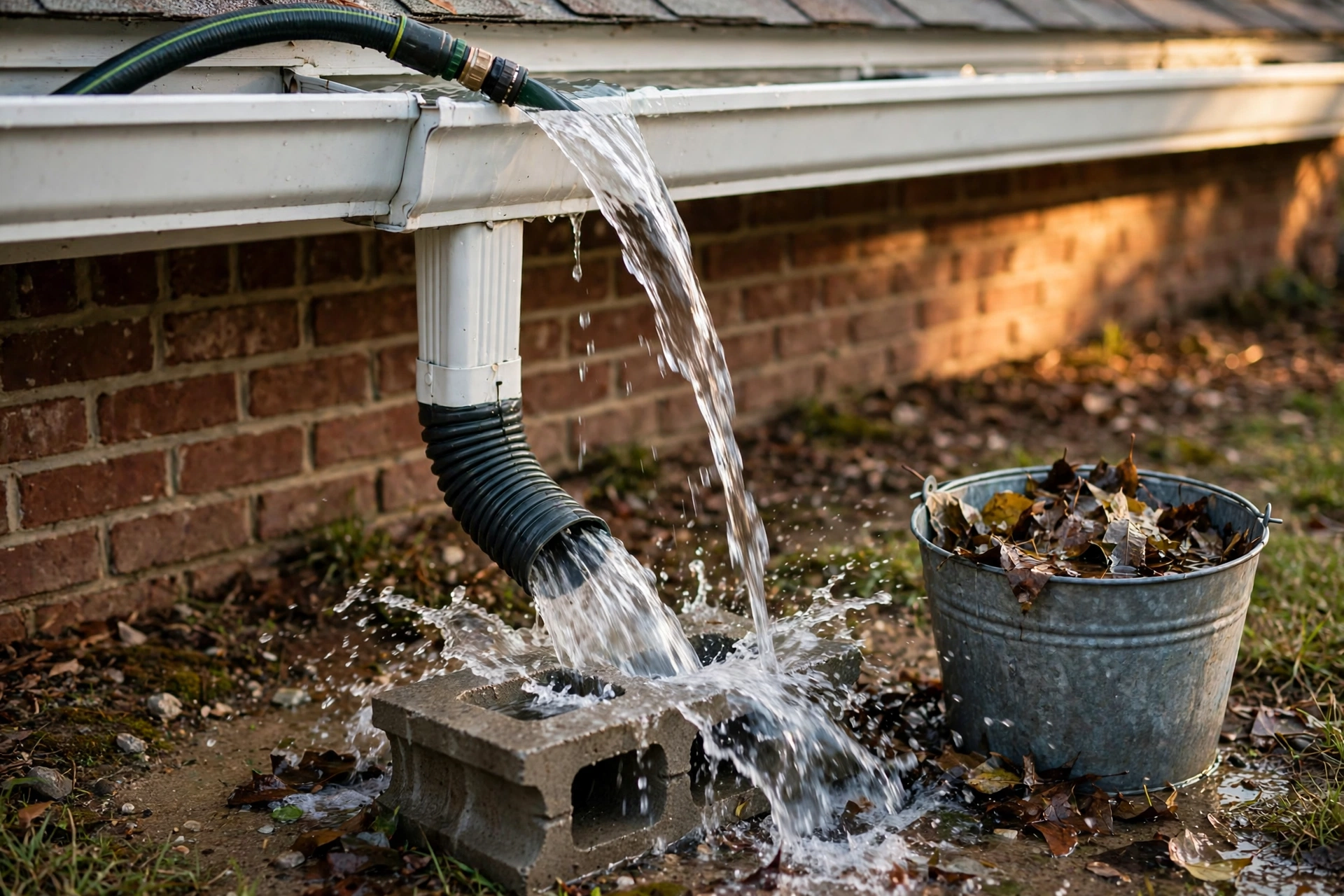
- Flush with the hose. Once a run is scooped, run water from the far end toward the downspout. This is the test, not just the rinse: watch how the water moves.
- Read the downspout. A healthy downspout roars. A clogged one dribbles at the seams or overflows the top. Most clogs sit at the elbow just below the gutter or at the bottom bend.
- Clear clogs from the bottom up. Remove the bottom elbow, tap and flush. A plumber’s hand snake handles the stubborn ones. Reassemble and flush again before you call it done.
While you’re up there, look at the gutter’s slope: standing water in a cleared gutter means a sagging run or a loose hanger — tighten or add a hanger now, not after it pulls away in a storm. It’s also the natural moment to check the roof edge before hanging lights — our outdoor Christmas light setup guide uses this same ladder, and one trip up can serve both jobs.
Step 3: Get the water away from the house
A clean gutter that dumps water at the foundation has done half a job.
- Extensions on every downspout that ends near the house — 4 to 6 feet minimum, sloping away.
- Splash blocks under short runs where an extension won’t fit.
- Check the grade while the hose is running: puddles against the foundation after a flush are telling you where the yard needs fill.
And while the hose is out and the ladder is up, this pairs naturally with our outdoor faucet winterizing guide — same morning, same shutdown-season checklist — and the leaf cleanup gear guide if the yard below is still carrying its own layer.
Our picks for gutter day
1. Gutter Scoop & Cleaning Tool Set
The right shape for the trough: a flexible scoop that matches the gutter profile, with a hanging hole for the bucket hook. Faster than a trowel and kinder to the gutter’s finish than metal tools.
→ Click here to check price on Amazon
2. Ladder Stabilizer / Standoff Bar
The safety pick that makes the whole list possible. Spans the gutter, holds the ladder off it, and turns a wobbly lean-to into a stable work platform.
→ Click here to check price on Amazon
3. Stainless Mesh Gutter Guards
For the house under oaks and pines, guards are the difference between this job twice a year and once every few years. Stainless mesh keeps the sludge layer out while letting water through; measure your gutter width (5 or 6 inch) before ordering.
→ Click here to check price on Amazon
4. Flexible Downspout Extension
The cheap fix for foundation puddles: bends around landscaping, extends to throw water 4+ feet out, and connects without tools on standard downspouts.
→ Click here to check price on Amazon
5. Heavy-Duty Work Gloves
Gutter work eats cheap gloves — screws, sheet-metal edges, and grit. A cut-resistant pair with a good grip is the difference between finishing the job and bandaging through it.
→ Click here to check price on Amazon
The mistakes that undo the job
- Flushing before scooping. The hose just turns loose leaves into a packed plug at the downspout. Scoop first, always.
- Ignoring a slow downspout. A trickle today is an overflow in the first real winter storm.
- Dumping at the foundation. Clean gutters plus a puddle at the wall is water damage on a delay.
- One-and-done in leaf country. Under heavy oaks, check again after the last leaf drop in December — five minutes with the hose tells you if you need a second pass.
The bottom line
Scoop it, flush it, watch the downspouts roar, and throw the water well clear of the house. An hour or two on a dry morning now is the cheapest water-damage insurance of the season — and with guards on the worst runs, it gets shorter every year.
Leave a Reply