Built & Backyard is reader-supported: we may earn a commission from qualifying purchases made through links on this page, at no extra cost to you.
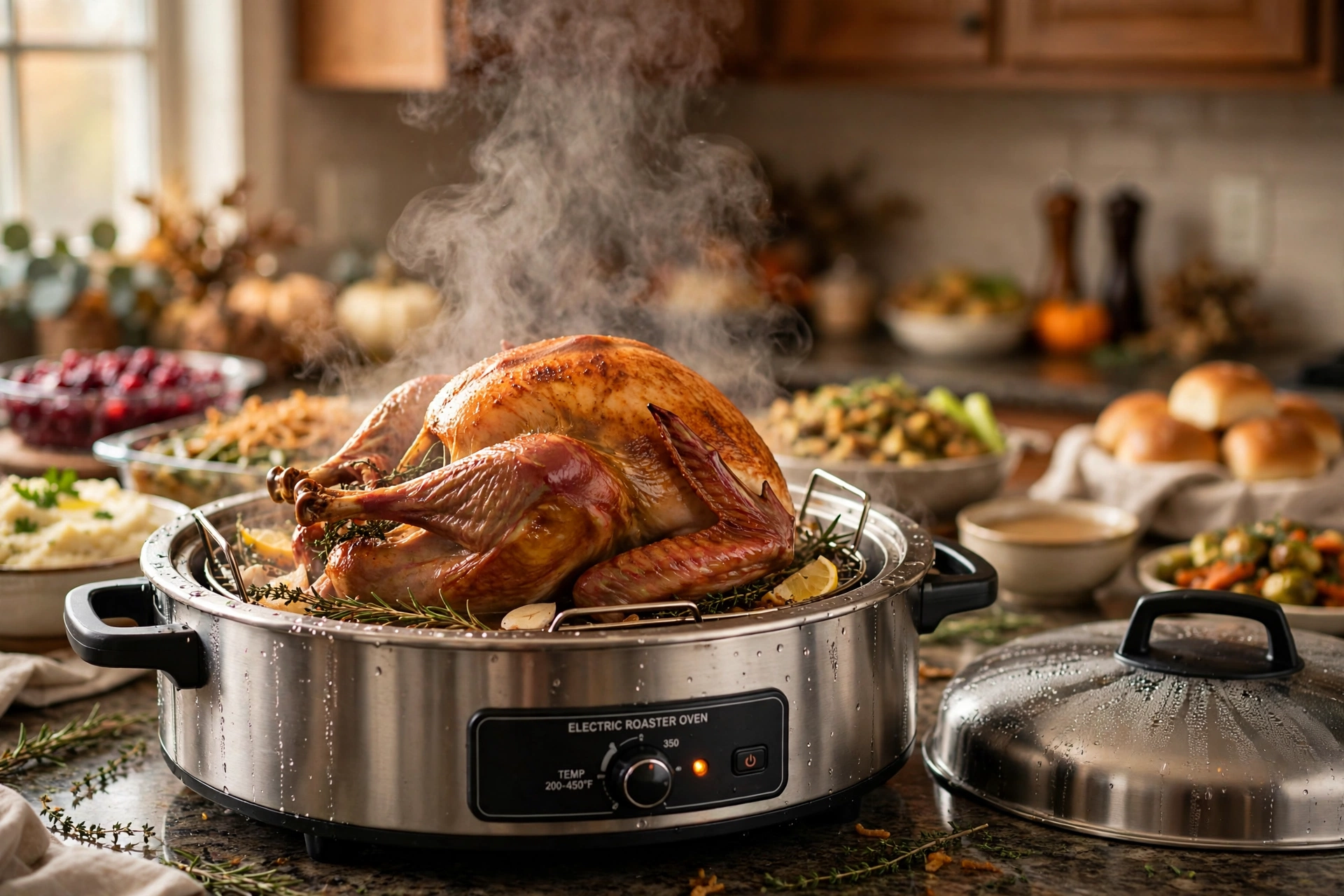
Every Thanksgiving kitchen runs the same failed math: one oven, a turkey that wants four hours in it, and a line of sides — dressing, sweet potatoes, rolls, a pie — that all want the same box at the same hour. The electric roaster oven is the oldest fix in the book, and it still works: a 22-quart countertop roaster cooks a bird up to about 24 pounds at a steady 325°F, moves to the counter, the porch, or the garage, and leaves the real oven entirely to the supporting cast. It pairs with the turkey fryer guide as the indoor, no-oil, no-weather option — and with Thanksgiving on Thursday, November 26 this year, a roaster bought this week arrives, washes, and does a test chicken long before the day itself. One honest trade-off up front: a roaster steams as it roasts, so the skin comes out paler than an oven bird’s unless you finish it — the fix is in Step 1.
Quick answer
Get a 22-quart electric roaster with a removable pan and a self-basting lid, cook the turkey at 325°F to 165°F in the deepest part of the thigh (about 15 minutes per pound, unstuffed), rest it a full 30 minutes in the turned-off roaster, and — for brown skin — give it 10 to 15 minutes in a hot 450°F oven at the end, which is free by then because the sides are already out. Never stuff a roaster bird, and never trust the pop-up timer over a thermometer.
Step 1: The roaster itself — 22 quarts, removable pan, self-basting lid
Size is the whole purchase: an 18-quart roaster tops out around an 18-pound bird, a 22-quart handles up to roughly 24 pounds and still fits a counter under standard cabinets with the lid on. The details that matter are the removable enamel or nonstick cooking pan (the bird lifts out in it and it goes in the sink), a rack in the bottom (a turkey that sits in its own drippings steams its underside), and a self-basting lid whose inner bumps rain the juices back over the breast instead of running them down the walls. The dial should be a true thermostat holding 150–450°F, because the same box becomes your keep-warm server, your ham warmer, and your biggest slow cooker the other 364 days.
Electric Roaster Oven, 22-Quart, with Self-Basting Lid & Removable Pan
Countertop capacity for a bird up to about 24 pounds, a lift-out pan and rack, and a 150–450°F dial that roasts on the day and holds at serving temperature through the meal.
→ Click here to check price on Amazon
Step 2: The temperature — an instant-read thermometer, not the pop-up
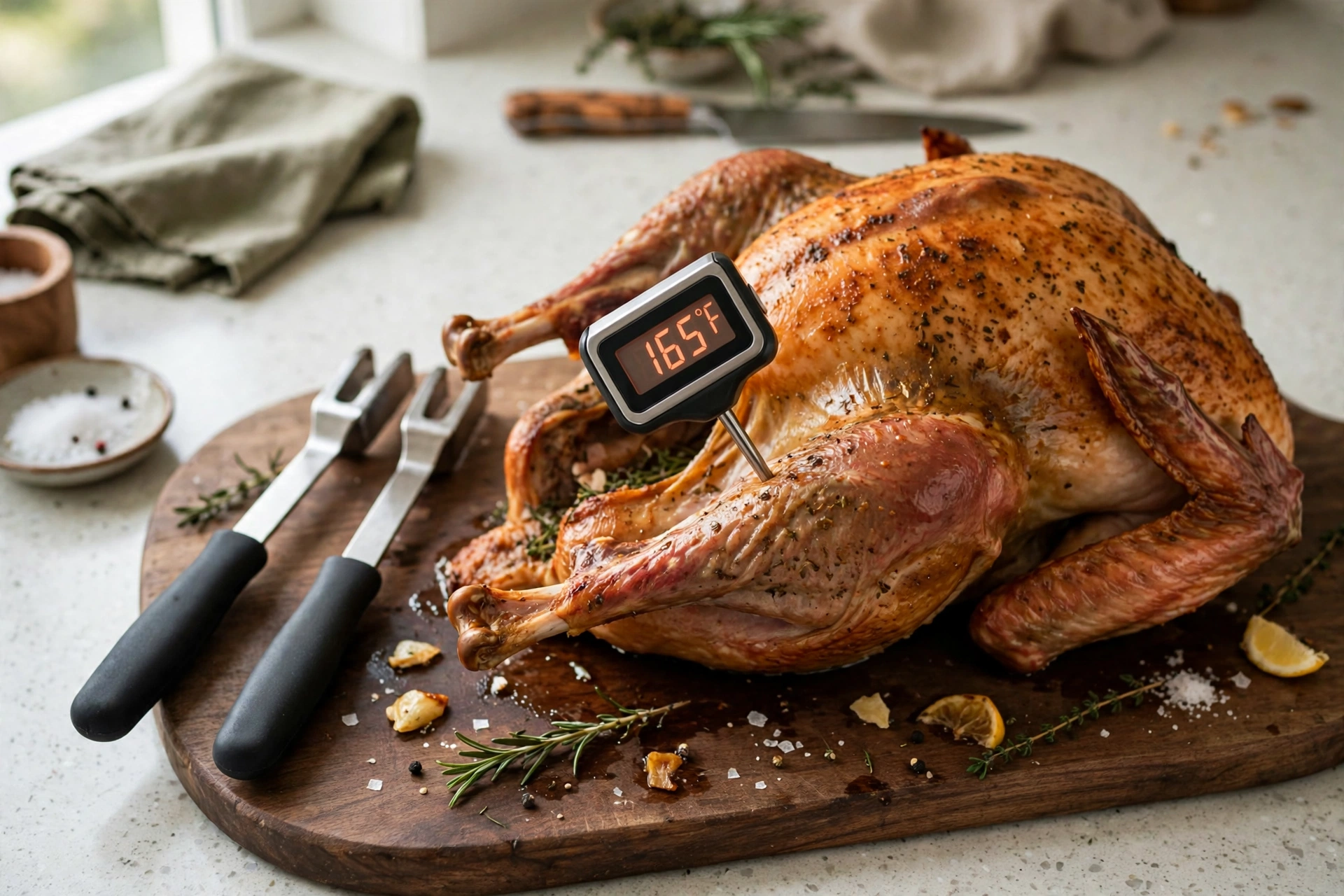
A roaster’s one real risk is the same as any turkey’s: the middle lies. The thigh can read done while the deep breast is still short, and the plastic pop-up that ships in most birds is set for a temperature that dries the breast out waiting. An instant-read thermometer ends the argument in three seconds: 165°F in the deepest thigh, not touching bone, and 160°F in the breast centre with carryover doing the rest during the rest. It is the same thermometer this site puts in the turkey fryer kit — one tool, both birds.
Instant-Read Meat Thermometer, Digital
Three-second reads and a thin probe for the deep thigh check — the difference between a turkey carved on schedule and one carved on a guess.
→ Click here to check price on Amazon
Already on this site’s hub: the instant-read meat thermometer is a pick in the Turkey Fryer guide too — listed once on the hub, on purpose.
Step 3: The lift — turkey lifters, because a hot 20-pound bird has no handles
Everything about roaster day goes smoothly until the moment a slick, steaming, 20-pound bird has to travel from a deep pan to a carving board. Two wide poultry lifters — pronged forks that go under the bird from both ends — turn that into a two-hand carry instead of a prayer, and they double as the steadying hold while the first slices come off. Twine trussing and a confident grip help; lifters are what actually work, and they cost less than the side dish a dropped turkey lands in.
Turkey Lifters, Stainless Poultry Forks, Set of 2
Wide pronged lifters that get under a hot bird from both ends — a controlled lift out of a deep roaster pan, and a steady hold for carving.
→ Click here to check price on Amazon
Step 4: The gravy — a fat separator for the roaster’s own drippings
A roaster quietly makes the best gravy argument of the day: the bird cooks in a closed box, so almost nothing evaporates, and the pan holds a deep well of drippings that an open oven pan loses to the air. A fat separator — pour the drippings in, let the fat rise, pour the rich juices out from the bottom spout — turns that well into smooth gravy instead of a greasy one, and it is faster and more reliable than skimming with a spoon over a hot pan while guests are arriving. Make the gravy in the roaster pan itself, right on the stovetop-safe removable insert if yours allows it, or in a saucepan with the separated juices.
Fat Separator Gravy Pitcher with Strainer, 4-Cup
Bottom-spout separation and a strainer lid — roaster drippings in, smooth pourable gravy stock out, with the fat left behind instead of skimmed.
→ Click here to check price on Amazon
Step 5: The carve — an electric carving knife for clean, even slices
A rested turkey deserves slices, not shreds. An electric carving knife’s reciprocating serrated blades do the one thing a tired cook with a dull knife cannot at the end of a long day: long, even, skin-on slices of breast, at whatever thickness the plate wants, without sawing the meat apart or pressing its juices onto the board. Keep the blades off the bone, let the knife do the moving, and use the lifters from Step 3 as your steadying fork. It earns its drawer space the rest of the year on hams, roasts, and crusty loaves.
Electric Carving Knife with Storage Case
Twin reciprocating serrated blades for even, skin-on turkey slices without the sawing — and a case that keeps the set together until the next holiday bird.
→ Click here to check price on Amazon
One oven was never going to be enough
Put the turkey in the roaster on the counter, give the oven to the dressing, the sides, and the pie, brown the bird with a short hot finish if you want the magazine skin, and carve it with a thermometer’s confidence behind you. Thanksgiving stops being a traffic jam and goes back to being a meal — and the house you prepped with the holiday guest prep guide gets fed on time. Every pick above — plus the rest of our kitchen and holiday gear — lives in one place on our Recommended Gear page.
Leave a Reply