Built & Backyard is reader-supported: we may earn a commission from qualifying purchases made through links on this page, at no extra cost to you.
Ask most homeowners where their fire extinguisher is and you’ll get a pause, then something like “under the sink, maybe?” Ask when they bought it and the pause gets longer. A fire extinguisher is the one tool in the house that has to work the first time, after sitting untouched for years, in the worst thirty seconds of your year. The good news: getting this right is cheap and takes one afternoon. The standard advice from fire departments is simple — one extinguisher on every level, one in the kitchen, one in the garage — but the details matter: the wrong class won’t put out a grease fire, a unit that’s too small runs dry before the fire does, and one mounted in the wrong spot might as well not exist. Here’s the full setup, room by room.
Quick answer
For most homes: buy three to four extinguishers. One 5 lb ABC extinguisher for the garage or workshop, one 2.5 lb ABC for each floor’s main living area, and a kitchen-rated unit within reach of the stove — but never right next to it. ABC is the class that covers ordinary combustibles, flammable liquids and electrical fires, which is nearly everything in a house. Mount each one near an exit, visible and reachable in two seconds, not buried behind paint cans. Then check the pressure gauge twice a year — the same weekends you check your smoke and CO detectors — and replace any unit that’s discharged, damaged, or past its service life.
What the letters and numbers actually mean
Extinguisher ratings look like alphabet soup, but they decode fast:
- Class A — ordinary combustibles: wood, paper, cloth, most plastics. This is most of what burns in a house.
- Class B — flammable liquids: gasoline, oil, grease, solvents. Your garage and kitchen live here.
- Class C — electrical fires: appliances, wiring, breaker panels. The agent won’t conduct electricity back into you.
- Class K — commercial cooking oils. This is for restaurant kitchens; home kitchens are covered by a kitchen-rated BC unit (below).
- The numbers — a 2-A:10-B:C rating means it handles roughly twice the Class A fire of a 1-A unit, and so on. Bigger number, more fire. For home use, a 2-A:10-B:C (about 2.5 lb) is the floor; a 4-A:60-B:C (about 5 lb) is the garage-and-workshop sweet spot.
An ABC extinguisher covers all three home classes in one can, which is why it’s the default recommendation. The one exception is the stove: a dedicated kitchen unit uses a gentler spray that won’t splash burning grease across the kitchen the way a hard ABC blast can.
How many, and where each one goes
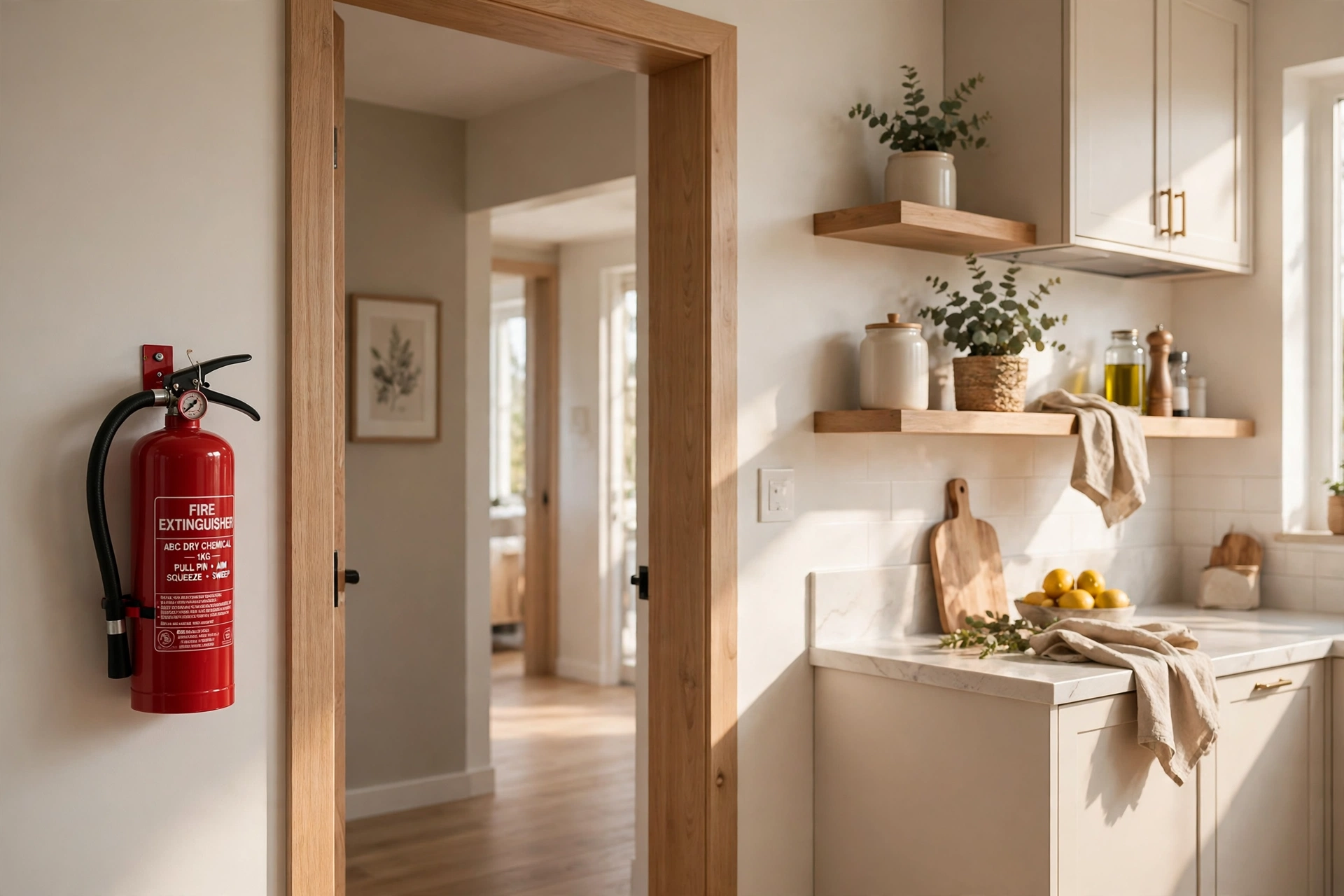
- Kitchen — the room where most home fires start. Mount it near the kitchen exit, not beside the stove: if the stove is what’s burning, you need to reach the extinguisher without reaching through the fire. You should be able to grab it with your escape route behind you.
- Each floor — one 2.5 lb ABC in a central, visible spot: a hallway closet door, the top of the basement stairs, a laundry room wall. Seconds matter more than size here.
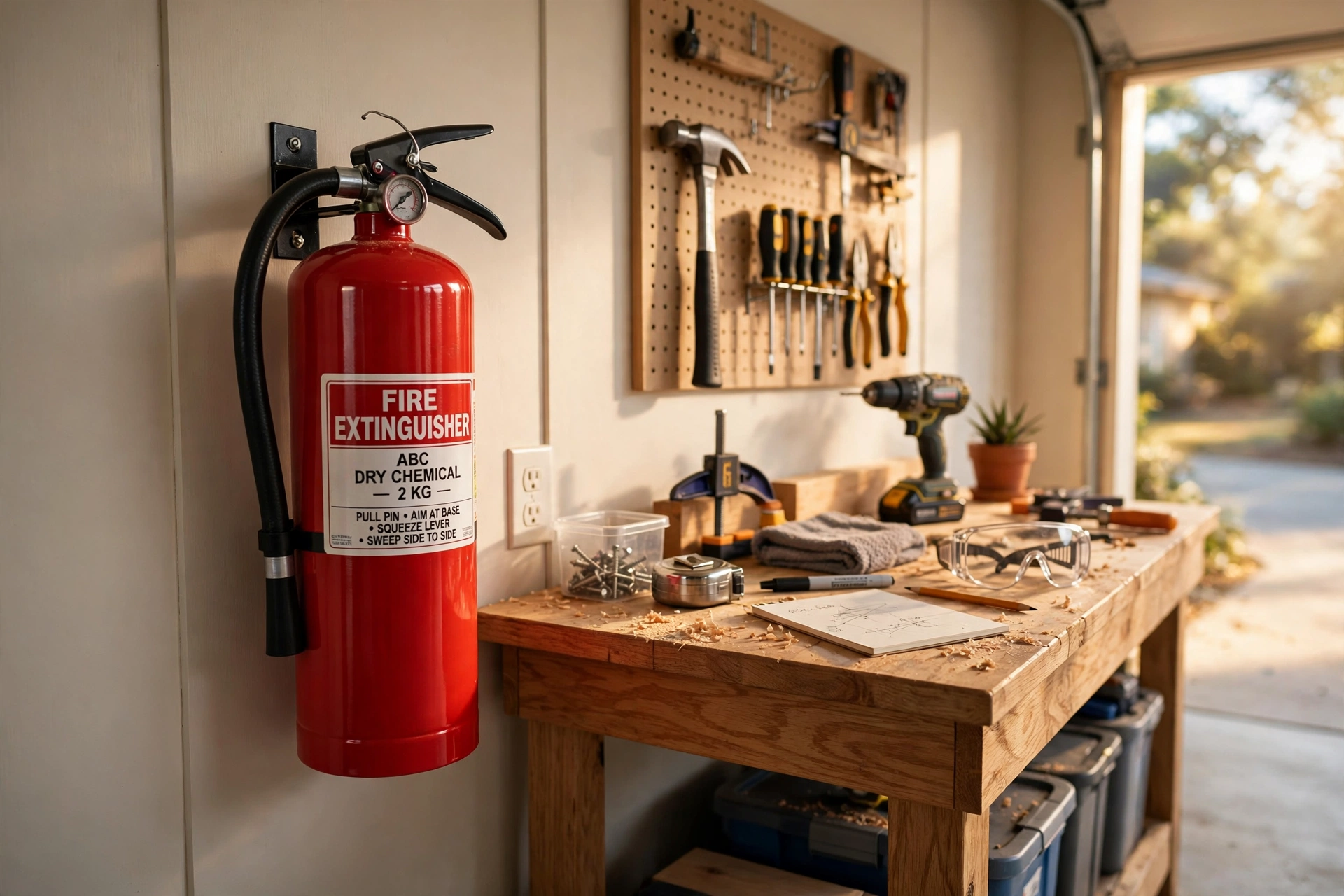
- Garage and workshop — the 5 lb unit, by the door into the house. Gas cans, solvents, chargers and power tools make this the highest-risk room after the kitchen, and the fires here start bigger.
- Near the bedrooms — if your floor-plan puts the main extinguisher far from where you sleep, add a compact unit in the primary bedroom closet. Night fires are the deadly ones.
- Skip — bathrooms and anywhere an extinguisher would block an exit or sit in direct heat (above the stove, next to the water heater).
One rule overrides everything: an extinguisher is for a small, contained fire with your exit at your back. If it’s spreading, if the room is filling with smoke, or if your first pull doesn’t knock it down — get out and call 911. No pan is worth it.
The picks
First Alert HOME1 standard home fire extinguisher — The default floor unit: 2.5 lb, rated 1-A:10-B:C, with a metal valve, a wall bracket included, and a pressure gauge you can actually read at a glance. It’s sized for the fires a hallway extinguisher actually meets — a trash can, a curtain, a small appliance — and it’s light enough that anyone in the house can handle it one-handed.
→ Click here to check price on Amazon
Amerex B402 ABC fire extinguisher — The garage and workshop pick: 5 lb, rated 4-A:60-B:C, all-metal valve construction, and the brand a lot of commercial buildings run. The extra capacity is the point — a fuel or workbench fire gives you one shot, and this holds roughly double the agent of a 2.5 lb unit. It also has the range to stand a few feet farther back, which you’ll appreciate.
→ Click here to check price on Amazon
First Alert kitchen fire extinguisher spray — Built for the stove: a compact aerosol-style spray rated for grease and cooking-oil fires that discharges in a gentler stream, so it smothers a pan fire instead of splashing it. It stores in a cabinet or on a small bracket near (not over) the cooktop, needs no shaking or gauge checks, and is the easiest unit in this guide for a nervous cook to actually use mid-panic.
→ Click here to check price on Amazon
Emergency fire blanket — The extinguisher’s partner, not its replacement: a fiberglass blanket in a quick-release pouch that smothers a stovetop or clothing fire by cutting off oxygen, with no powder cloud and no cleanup. Hang one beside the kitchen extinguisher. It’s also the safest first move on a person whose clothes catch — wrap, don’t spray.
→ Click here to check price on Amazon
Kidde FA110 multipurpose fire extinguisher — The compact second-floor and bedroom pick: 2.5 lb ABC, light, with a strap bracket that mounts inside a closet door or on an RV or boat just as easily. This is the one to add where a full-size unit would never get installed — upstairs, in the primary bedroom, or in the car for the garage-to-house commute of a lithium battery fire you never want to meet unprepared.
→ Click here to check price on Amazon
Keep them ready: the two-minute check
An extinguisher you never look at is a decoration. Twice a year — pair it with your smoke and CO detector check — walk the house and confirm four things on every unit: the gauge needle is in the green, the pin and tamper seal are intact, the hose and nozzle are clear and uncracked, and the can has no rust, dents or leaks. Pick each one up: a 2.5 lb unit that feels suspiciously light has leaked its charge. Dry-chemical units also benefit from a flip and a shake once a year — the powder settles and cakes over time, and inverting the can keeps it loose and ready to flow. Most home units carry a service life of 10–12 years from the manufacture date stamped on the label; write the purchase date on the can with a marker the day it goes up, and when the date passes, replace it — don’t gamble a decade-old pressure vessel against a live fire. And teach the house the word PASS: Pull the pin, Aim at the base of the fire, Squeeze, Sweep side to side. The aiming point is the whole trick — spray the flames and you accomplish nothing; spray the base and the fire starves.
Get the count right, put them where hands can find them in the dark, and check them when you check the detectors. It’s the cheapest insurance in the house, and unlike insurance, it works in the first thirty seconds.
Leave a Reply