Built & Backyard is reader-supported: we may earn a commission from qualifying purchases made through links on this page, at no extra cost to you.
A pressure washer almost never dies in the summer. It dies quietly in the garage in December, when the water still sitting inside the pump freezes, expands, and cracks the manifold — and the owner finds out in March, at the first spring cleaning, with a pump that leaks from a seam no seal kit will fix. The fix is a 20-minute routine done once in the fall, and it is the same logic as our pipe freeze prevention guide: water left where it can freeze is the whole problem. This is the last of the fall winterizing run — the lawn mower got the same treatment, for the same reasons.
Quick answer
Run pump saver through the pump until it comes out the outlet, treat the fuel with stabilizer (or drain it), pull the trigger to clear the wand and hose, disconnect and drain every hose, and store the machine somewhere that does not freeze hard. The pump is the expensive part and the vulnerable part — everything in this routine exists to get plain water out of it and antifreeze in.
Step 1: The pump is the part that freezes
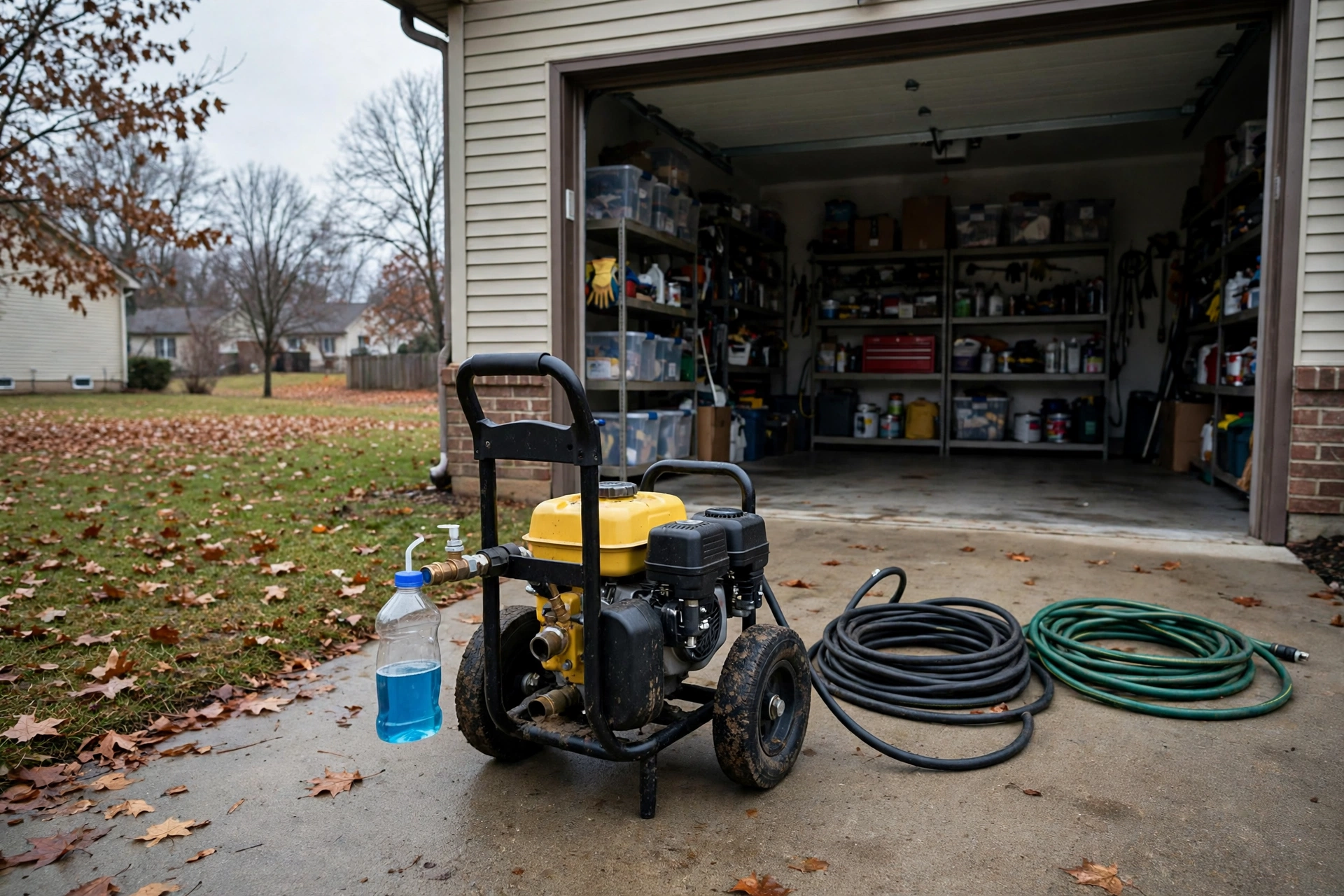
A pressure washer pump holds water in its manifold, valves, and unloader long after the hose is drained. That trapped water is what cracks pumps, and gravity alone will not clear it. Pump saver — a combined antifreeze and lubricant made for exactly this — displaces the water, coats the seals so they do not dry out over winter, and stays liquid at temperatures that would crack a water-filled pump. Thread the bottle onto the garden-hose inlet, run the machine (or squeeze per the bottle’s directions) until pump saver comes out the high-pressure outlet, and the pump is done for the winter.
Pressure Washer Pump Saver (antifreeze & lubricant)
The one product this whole guide exists for: antifreeze protection for the pump plus lubricant that keeps seals and pistons from drying out over winter storage.
→ Click here to check price on Amazon
Step 2: The fuel system — stabilize it or drain it
Gas left sitting from November to March is the same stale-fuel problem as the mower, and a gas pressure washer has the same two honest choices: fill the tank with fuel treated with stabilizer and run the engine a few minutes to circulate it, or drain the system completely. The stabilizer already recommended in our lawn mower winterizing guide is the same bottle — buy it once and it covers every small engine in the garage. If draining is the plan, a hand siphon pump moves the fuel back into a can without a mouthful of gasoline or a spilled tank.
Fuel stabilizer: STA-BIL Storage
The one bottle that prevents the most common spring failure — treat the last tank of the season, run the engine a few minutes to circulate it, and the fuel system is done.
→ Click here to check price on Amazon
Fuel Siphon Transfer Pump
Drains a small-engine tank cleanly into a gas can — the no-spill way to empty the washer, the mower, or the generator before storage.
→ Click here to check price on Amazon
Step 3: Clear the wand, the hose, and the nozzles
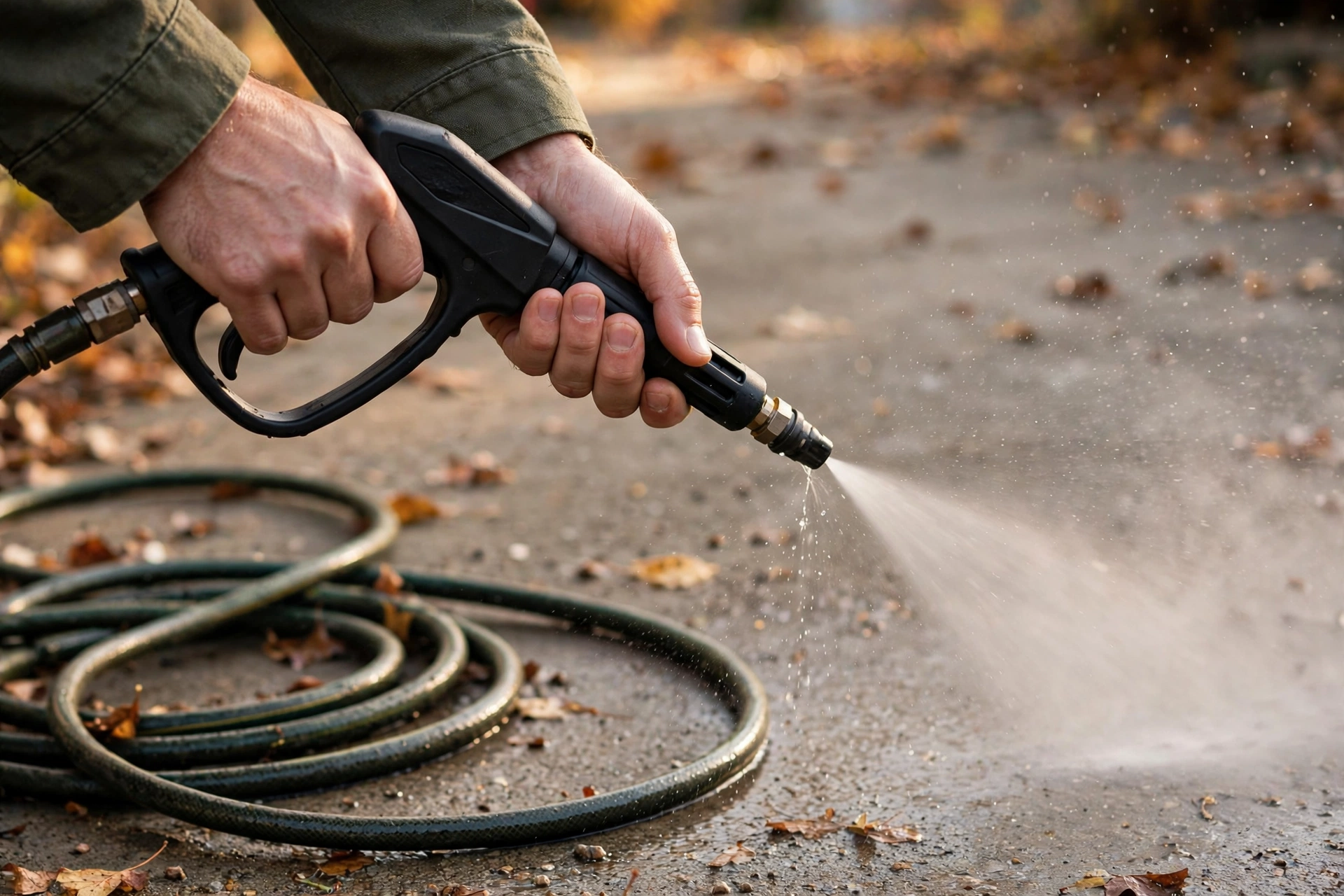
With the water supply off and the machine shut down, squeeze the trigger until the wand and high-pressure hose run dry — that water freezes too, and a split hose is the spring’s second surprise. Pull the nozzle tips, rinse out the grit that summer left in them, and let them dry before they go back in their holder: a tip stored wet corrodes, and a corroded tip sprays a pattern like a sprinkler. Fall is also when worn tips show themselves; a fresh matched set costs little and makes the machine spray like it did new.
Pressure Washer Nozzle Tips Set (quick-connect, with turbo nozzle)
The standard fan tips plus a turbo nozzle, sized for common homeowner machines — replaces the worn, grit-scored tips that ruin the spray pattern.
→ Click here to check price on Amazon
Step 4: Hoses off, drained, and stored loose
Disconnect the garden hose and the high-pressure hose, drain both, and coil them loose — tight coils stored frozen stiff are how hose liners crack. Our outdoor faucet guide covers the spigot side of this same job; the washer side is simply: nothing connected, nothing holding water, nothing kinked. If the detergent tank or siphon tube holds soap solution, flush it with clean water before storage so dried detergent does not plug the injector in spring.
Step 5: Store it covered, off the concrete if you can
A washer stored clean and dry under a breathable cover stays that way; a washer stored bare collects a winter of garage dust in every port, and the mice find the air filter. A fitted, water-resistant cover is cheap insurance, and storing the machine on a shelf or a piece of plywood instead of bare cold concrete keeps the pump housing off the coldest surface in the garage. Electric models skip the fuel steps entirely — for them, Steps 1, 3, and 4 are the whole job.
Pressure Washer Storage Cover (water-resistant, fitted)
Keeps dust, drips, and garage grit out of the pump ports and engine all winter — sized for standard homeowner washers, with a drawstring hem.
→ Click here to check price on Amazon
Winterizing, settled
Pump saver in the pump, the fuel stabilized or gone, the wand and hoses drained dry, the tips clean, and the machine covered off the concrete. Twenty minutes in November, or a pump replacement in March — the math has never been close.
Leave a Reply