
Built & Backyard is reader-supported: we may earn a commission from qualifying purchases made through links on this page, at no extra cost to you.
Every November the same thing happens in Louisiana: the Bermuda, St. Augustine, and centipede go dormant and turn the color of a paper bag, and the yard stays that way until March. It does not have to. Overseeding with winter ryegrass is the Southern trick for a green lawn all winter — the LSU AgCenter puts Louisiana’s overseeding window at October 1 through November 15, with late October and early November the normal seeding time, so right now is the tail of the window, not the middle of it. Wait much longer and the cooler weather works against germination. This is a one-weekend job, and it is the natural next step after the fall lawn winterizer application that feeds the warm-season grass underneath.
Quick answer
Mow the dormant lawn a little shorter than usual (do not scalp it), then broadcast perennial ryegrass at 5 to 10 pounds of seed per 1,000 square feet — 8 pounds is the sweet spot, and use the higher end, 8 to 10, over St. Augustine. Split the seed into two passes, half walked north–south and half east–west, then keep the soil consistently moist until it germinates in about a week. Perennial ryegrass is the LSU AgCenter’s recommendation for home lawns: finer, darker, and better behaved than annual rye in spring.
Step 1: Pick the seed — perennial, not annual
The bag choice decides how the lawn looks in December and how it behaves in April. Annual ryegrass is cheaper and germinates fast, but it grows coarse, clumps, and can linger shaggily. Perennial ryegrass — the turf-type kind — comes up almost as quickly, cuts cleaner at normal mower heights, and is what the LSU AgCenter recommends for Louisiana home lawns. Buy fresh seed with a recent test date on the label, and size the bag to your measured lawn: at 8 pounds per 1,000 square feet, a 5,000-square-foot lawn drinks a full 40 pounds, so the big bag is usually the honest buy.
Perennial Ryegrass Seed, Turf-Type (20–50 lb bag)
The finer, darker perennial the extension service recommends over annual rye — germinates in about a week and mows clean all winter.
→ Click here to check price on Amazon
Step 2: Spread it even — two passes, crisscross
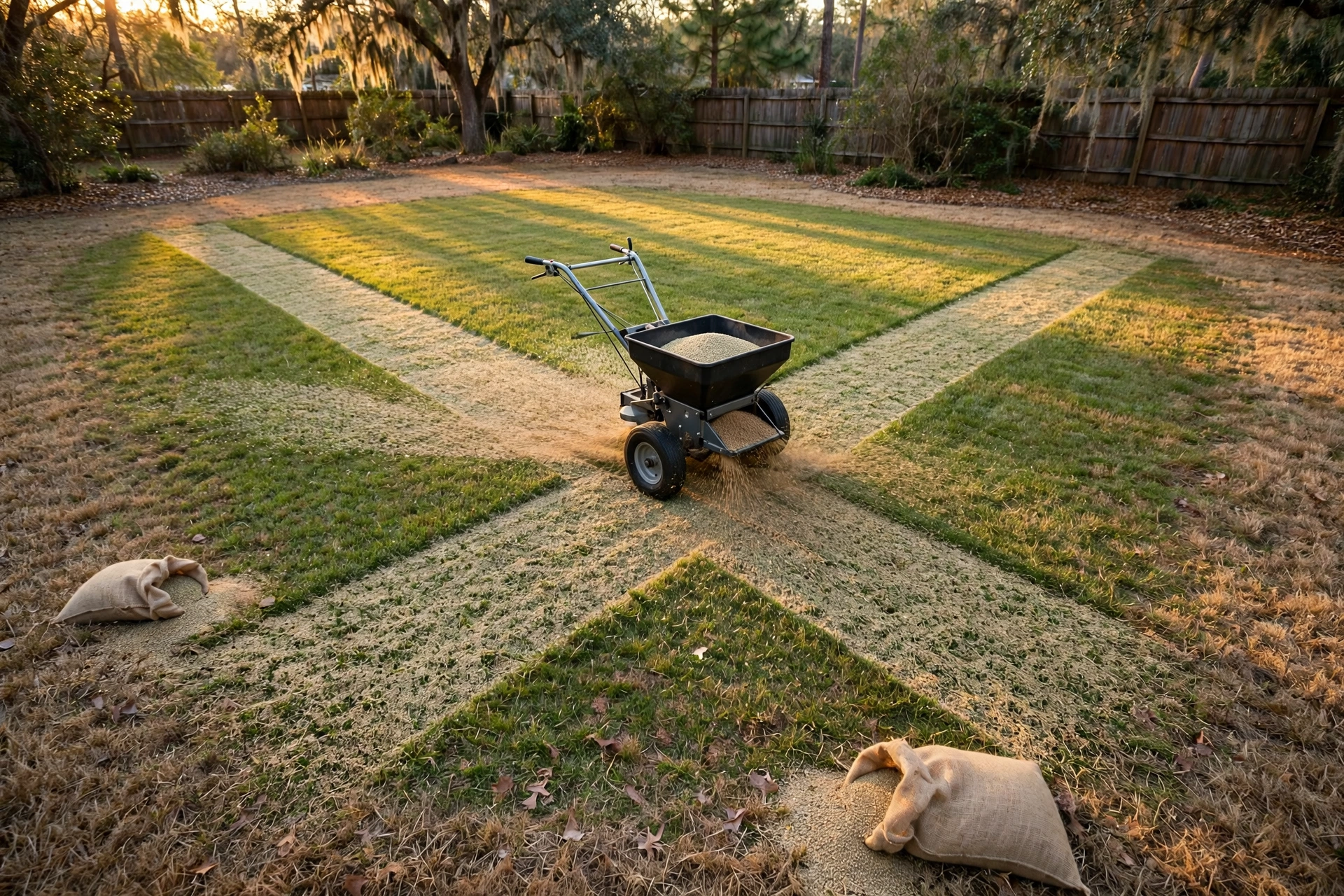
Stripes in an overseeded lawn are almost never the seed’s fault — they are one heavy pass in one direction. The fix is the crisscross the LSU AgCenter teaches: load half the seed, walk it north–south, load the other half, and walk it east–west. A broadcast (rotary) spreader throws wide and even for a full lawn; a handheld spreader is fine for a small front yard. Calibrate on the driveway first — you want the rate dialed to deliver your target pounds, not a guess — and sweep the strays off the concrete so they do not stain or sprout in the cracks.
Broadcast Spreader, Walk-Behind with Edge Guard
Wide, even throw with an edge guard that keeps seed out of the beds and off the driveway — the two-pass crisscross takes twenty minutes a lawn.
→ Click here to check price on Amazon
Step 3: Water for germination — moist, not drowned
Ryegrass germinates in roughly a week, but only if the seed bed stays consistently moist the whole time — seed that dries out mid-germination dies mid-germination. If rain is not in the forecast, water lightly and often: short cycles that keep the top of the soil damp without puddling or washing seed into the low spots. A hose-end timer turns that into a set-and-forget schedule instead of a week of standing in the yard with a nozzle, and once the grass is up and established — about a month — you can back off to normal watering.
Hose-End Water Timer, Programmable
Set the short, frequent cycles germination needs and let the timer keep the seed bed moist while you are at work — no drowned seed, no dried-out seed.
→ Click here to check price on Amazon
Step 4: Feed it once it is up — and skip the pre-emergent
Two rules that save overseeded lawns. First: do NOT put a pre-emergence herbicide down after seeding — it will stop the ryegrass from germinating right along with the weeds. Second: about a month after seeding, once the rye is established, feed it — the LSU AgCenter’s classic guidance is 8 to 12 pounds of 13-13-13 per 1,000 square feet at that point, delayed on purpose so the warm-season grass underneath does not wake up and compete. The dense rye itself does most of your winter weed work for free: it crowds out annual bluegrass, henbit, and chickweed by simply being there first.
13-13-13 All-Purpose Fertilizer
The balanced feed an established overseed wants, a month after germination — the same bag handles the beds and the vegetable garden the rest of the year.
→ Click here to check price on Amazon
Step 5: Mow it right, then hand the lawn back in spring
Mow ryegrass at 1 to 2.5 inches all winter, a touch higher than you cut the summer lawn, and keep the blade sharp — rye tears instead of cutting under a dull blade and the tips brown off. The spring handoff matters as much as the seeding: when warm weather returns, mow the rye progressively lower so light reaches the Bermuda or St. Augustine underneath and it can green up on schedule; ryegrass left tall and shady into May competes with the lawn you actually planted. One honest note from the AgCenter: overseeding every single year can thin the warm-season stand over time, so treat it as a most-years tool, not an autopilot. When mowing season ends for the summer grass, our lawn mower winterizing guide covers putting the machine itself to bed.
Replacement Mower Blade / Blade Sharpening Kit
A sharp edge is the difference between cut ryegrass and torn ryegrass — swap or hone the blade before the winter mowing season, not after the tips brown.
→ Click here to check price on Amazon
Green until March
Perennial seed at eight pounds to the thousand, two crisscross passes, a week of kept-moist watering, one feeding a month in, and a low mow to hand the yard back in spring. That is the whole Louisiana winter-lawn trick — and the window the AgCenter gives it closes November 15, so this is the weekend to do it. Every pick above — plus the rest of our lawn and outdoor gear — lives in one place on our Recommended Gear page.
Leave a Reply