Disclosure: This post contains affiliate links. If you buy through them, Built & Backyard may earn a commission at no extra cost to you.
Quick answer
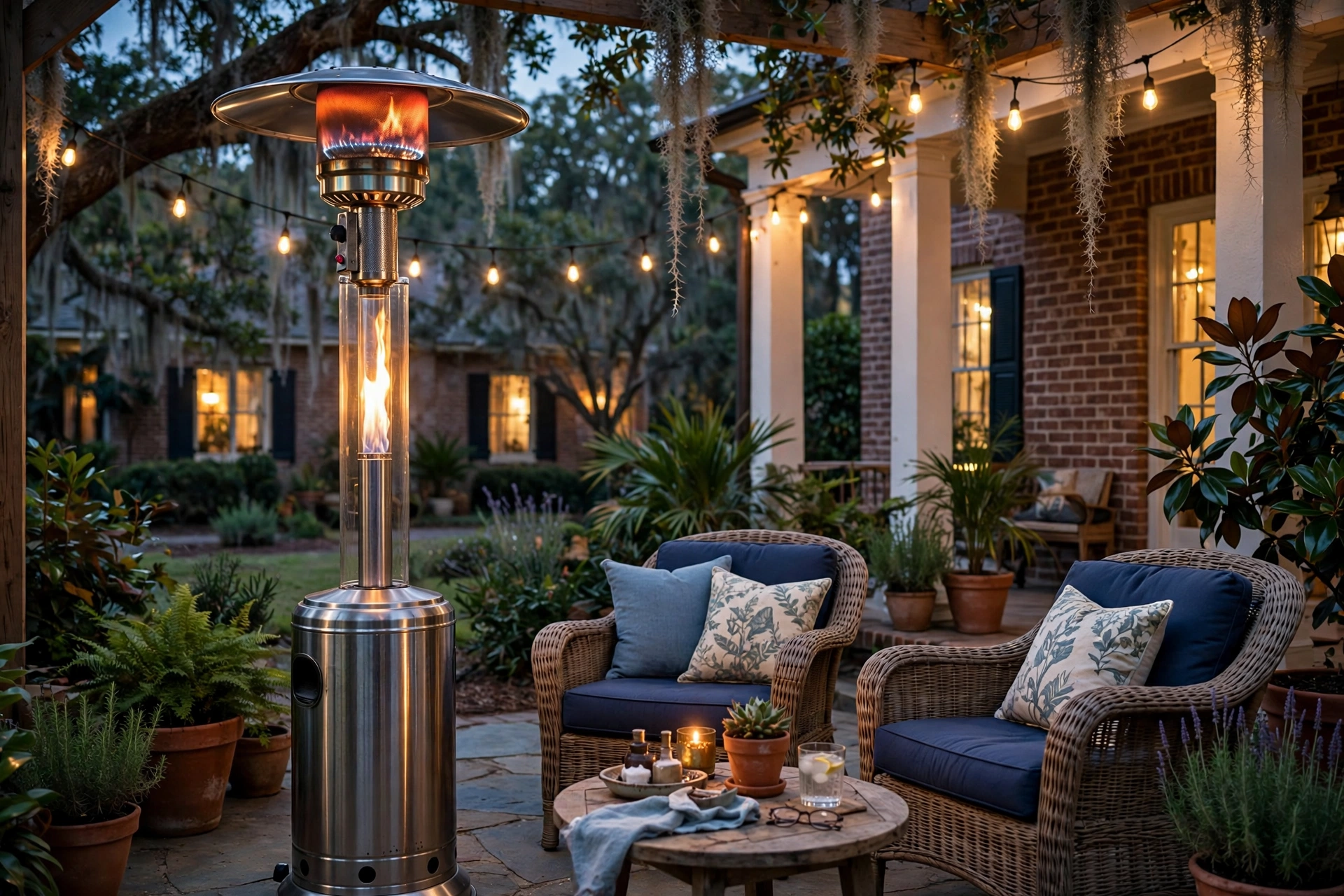
For most patios, one 48,000 BTU standing propane heater covers a circle about 10–15 feet across in calm air — roughly one seating area, not a whole deck. A tabletop propane heater (around 10,000–11,000 BTU) warms the people at one table. A 1,500-watt electric infrared heater warms whoever is in front of it, about a 6–8 foot zone, and costs pennies an hour to run. Size by the seating area you actually use, place the heater upwind of it, and buy for the wind you get — wind, not square footage, is what steals patio heat.
This is the cool-evening half of patio season. It pairs with our outdoor TV setup guide — a heater is what keeps that TV watchable in November — and with our outdoor Christmas light setup, because the same holiday gatherings that go up with the lights are the ones standing around outside after dark.
Why Southern patios need a different sizing rule
In Louisiana and across the South, patio season doesn’t end — it shifts. November through February evenings run 40–60°F: too cool to sit still outside in a light jacket, nowhere near cold enough to move the gathering indoors. You are not heating against a blizzard. You are raising the feel of one seating area by about 10–15 degrees for three or four hours.
That changes the math in your favor:
- You need less heater than northern guides suggest. A heater rated to be marginal in Minnesota is generous here.
- The season is long. A heater bought in November gets used for months, not weeks — which makes a mid-range heater a better buy than the cheapest one.
- Humidity helps you slightly. Damp cool air feels colder on skin, but radiant heat (what patio heaters actually deliver) cuts straight through that — you feel the infrared, not the air temperature.
Step 1: Measure the seating area, not the patio
Patio heaters deliver radiant heat in a circle or a cone. Nobody needs the whole slab warm — you need the chairs warm.
- One table, 4–6 people: a circle about 8–10 feet across. A tabletop heater centered on the table, or one standing heater at the edge, covers it.
- A seating group (sofa/chairs around a coffee table or fire table): about 10–12 feet across. One 48,000 BTU standing heater, placed at the edge closest to the wind.
- A long deck with two zones: two smaller heaters beat one big one. Radiant heat falls off fast with distance — someone 12 feet from a single heater feels almost nothing, no matter what the box claims.
Rule of thumb: plan on roughly 3,000–4,000 BTU per person in the seating area for Southern cool evenings, and halve the manufacturer’s claimed coverage circle if your patio is exposed to wind.
Step 2: Pick your fuel
Standing propane (40,000–48,000 BTU)
The default for a reason. No cord, no install, rolls where you need it, and a standard 20 lb tank (the grill size — most models hide it in the base) runs roughly 8–10 hours on high. Best for: the main seating area on an open patio or deck. Downsides: the heat rises, so tall ceilings and open air waste some of it, and wind leans the heat circle downwind.
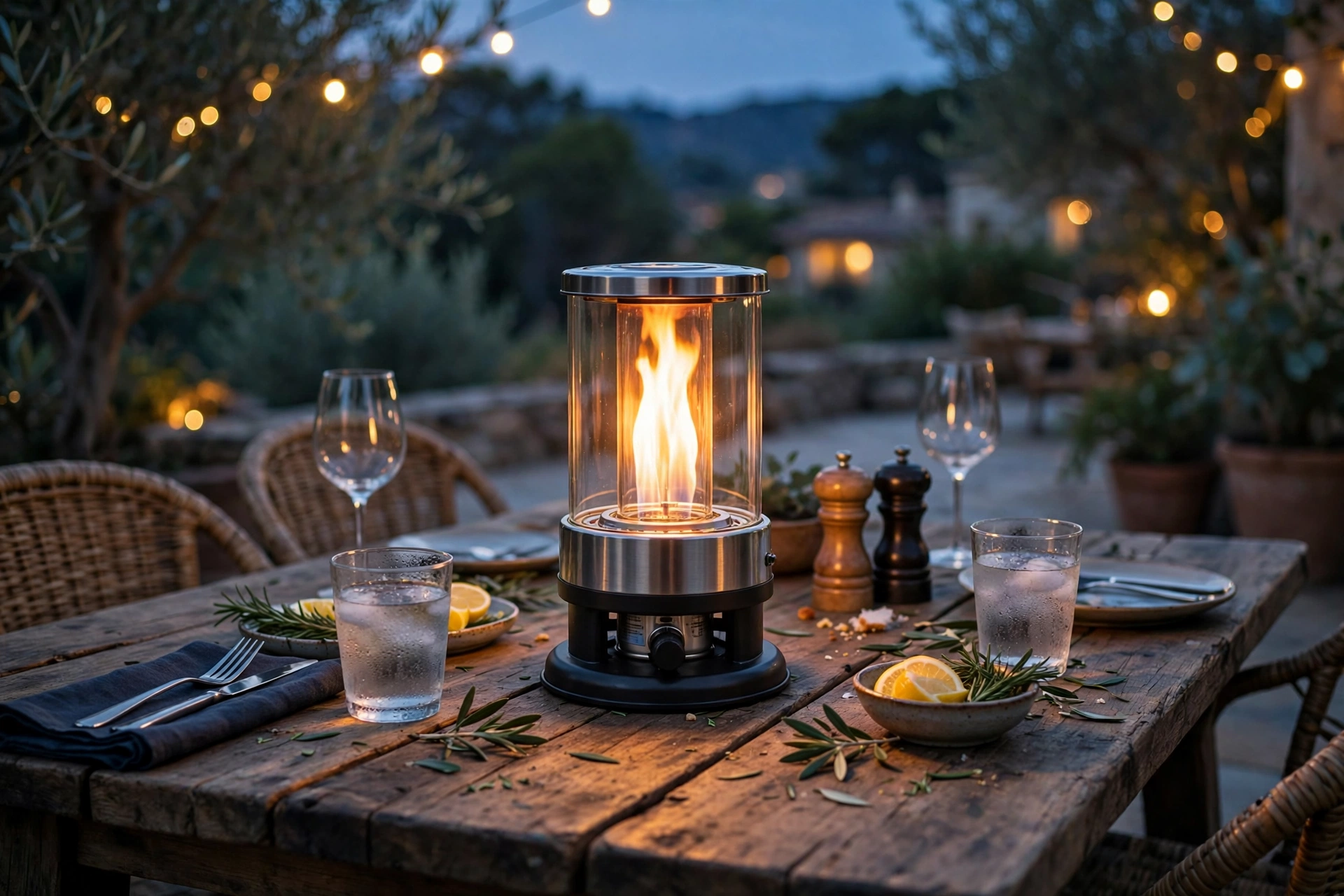
Tabletop propane (around 10,000–11,000 BTU)
Sits in the middle of a patio table and warms the people around that table — exactly where the heat is wanted, at head and shoulder height while seated. Runs on 1 lb camping cylinders (a few hours each) or a hose adapter to a 20 lb tank. Best for: dining tables and small decks. It is not a whole-patio heater, and it needs the table umbrella hole or a stable flat center to sit on.
Electric infrared (1,500 watts, wall- or ceiling-mount or tripod)
Silent, instant, no flame, no tank to swap, and the cheapest to run per hour. Because it mounts up and aims down, it wastes less heat to the sky than a standing propane unit. Best for: covered patios, screened porches, and outdoor kitchens — anywhere with a ceiling or a wall to mount to and an outlet in reach. Downsides: it only warms what it points at, and a standard 15-amp circuit is basically dedicated to it while it runs — which is the same circuit math as our Christmas light breaker guide: don’t stack a heater and a big light display on one circuit and act surprised.
Natural gas
Worth it only if you already have a gas line at the patio (common with outdoor kitchens). No tanks ever, but it’s a fixed install — skip it for a first heater.
Step 3: Respect wind and clearance
- Place the heater upwind of the seating. Radiant heat doesn’t blow away like warm air does, but the flame pattern and the heat cone both shift downwind. Upwind placement puts your chairs in the fat part of the cone.
- Clearance is non-negotiable. Most standing heaters want about 3 feet of clearance on all sides and well over head height to anything combustible — more under a covered patio, where many manufacturers say not to use a propane tower at all. Read your model’s numbers, not this paragraph’s. Under a low cover, a mounted electric infrared is the right tool.
- Never run any fuel-burning heater in an enclosed porch or garage. Carbon monoxide doesn’t announce itself. For warming a closed garage workshop, that’s a different problem — our garage heater sizing guide covers the heaters actually rated for it.
- Tip-over and wind: a standing heater with a weighted or sand-filled base, or one with an automatic tip shutoff, is worth the small premium on an exposed deck. Gulf wind gusts do not care about your evening plans.
Step 4: Running costs, honestly
- Propane standing heater: a 20 lb refill runs roughly $15–$20 and lasts 8–10 hours on high — call it about $2 an hour at full blast, less once you turn it down after the first warm-up.
- Tabletop on 1 lb cylinders: the convenient but pricey way — a few dollars per evening. The 20 lb adapter hose pays for itself fast if you use it weekly.
- Electric infrared: 1,500 watts for an evening is a few kilowatt-hours — well under a dollar a night at Louisiana rates. If you have the covered patio for it, it’s the cheap seat-warmer by a mile.
The patio heater checklist
- Measure the seating circle you actually use (usually 8–12 feet).
- One seating zone = one heater. Two zones = two smaller heaters.
- Open patio → standing propane. Dining table → tabletop. Covered patio/porch → mounted electric infrared.
- Place it upwind of the chairs.
- Check the manufacturer’s clearances before the first lighting, not after.
- Buy the cover at the same time — a heater that lives outside all winter needs one.
Get the sizing right and November evenings on the patio feel like October. And when the genuinely hot half of the year comes back, our cool tech for Southern living guide covers the other direction — beating the heat instead of adding to it.
Picks for the job
Standing propane patio heater, 48,000 BTU, with wheels
The main-seating-area heater: standard 20 lb tank in the base, rolling base for repositioning, tip-over shutoff.
→ Click here to check price on Amazon
Tabletop propane patio heater
Head-height heat for one dining table. Runs on 1 lb cylinders, or add the adapter hose below for a 20 lb tank.
→ Click here to check price on Amazon
Electric infrared patio heater, wall-mount, 1,500W
For covered patios and screened porches: mounts up, aims down, silent, and the cheapest to run per evening.
→ Click here to check price on Amazon
Propane tank adapter hose (1 lb to 20 lb)
Lets a tabletop heater run off a full-size grill tank instead of pricey 1 lb cylinders.
→ Click here to check price on Amazon
Patio heater cover, waterproof
A heater that lives outside through a wet Southern winter needs a cover — reflectors and valves corrode fast left bare.
→ Click here to check price on Amazon
Mistakes that leave people cold
- Believing the box coverage circle. Manufacturer circles assume no wind and a mild night. Halve it for an exposed patio.
- One huge heater for two seating zones. Radiant heat dies with distance. Two smaller heaters win every time.
- Putting a propane tower under a low patio cover. Clearance rules exist because ceilings catch heat — and worse. Use mounted electric there instead.
- Forgetting the tank runs out mid-evening. A gauge, a spare tank, or an electric backup keeps the gathering from ending early.
- Storing it uncovered all winter. Rain in the reflector and burner is how a two-year heater happens.
Leave a Reply