Built & Backyard is reader-supported: we may earn a commission from qualifying purchases made through links on this page, at no extra cost to you.
Heating season is when a house runs its most dangerous equipment the most hours: a furnace cycling all night, a gas water heater, a fireplace on weekends, a space heater in the cold room. Every one of them is a carbon monoxide source if it malfunctions, and CO has no smell, no colour, and no warning of its own — the detector is the warning. Smoke alarms have the quieter version of the same problem: they expire. The sensor inside a smoke alarm is rated for about ten years and a CO sensor for five to seven, and an expired alarm with a fresh battery still chirps and tests fine while sensing almost nothing. Winter is the right season to check, because winter is when it matters — our fireplace and chimney safety guide covers the fire itself; this one covers the alarms standing guard over all of it.
Quick answer
Check the manufacture date printed on the back of every alarm: replace smoke alarms at 10 years and CO alarms at 5–7, batteries or no batteries. You want coverage on every level, inside every bedroom, and outside every sleeping area — and a combination smoke/CO unit with a 10-year sealed battery is the simplest way to get there, because it never needs a battery swap in its whole service life.
Step 1: Read the date — the test button is not enough
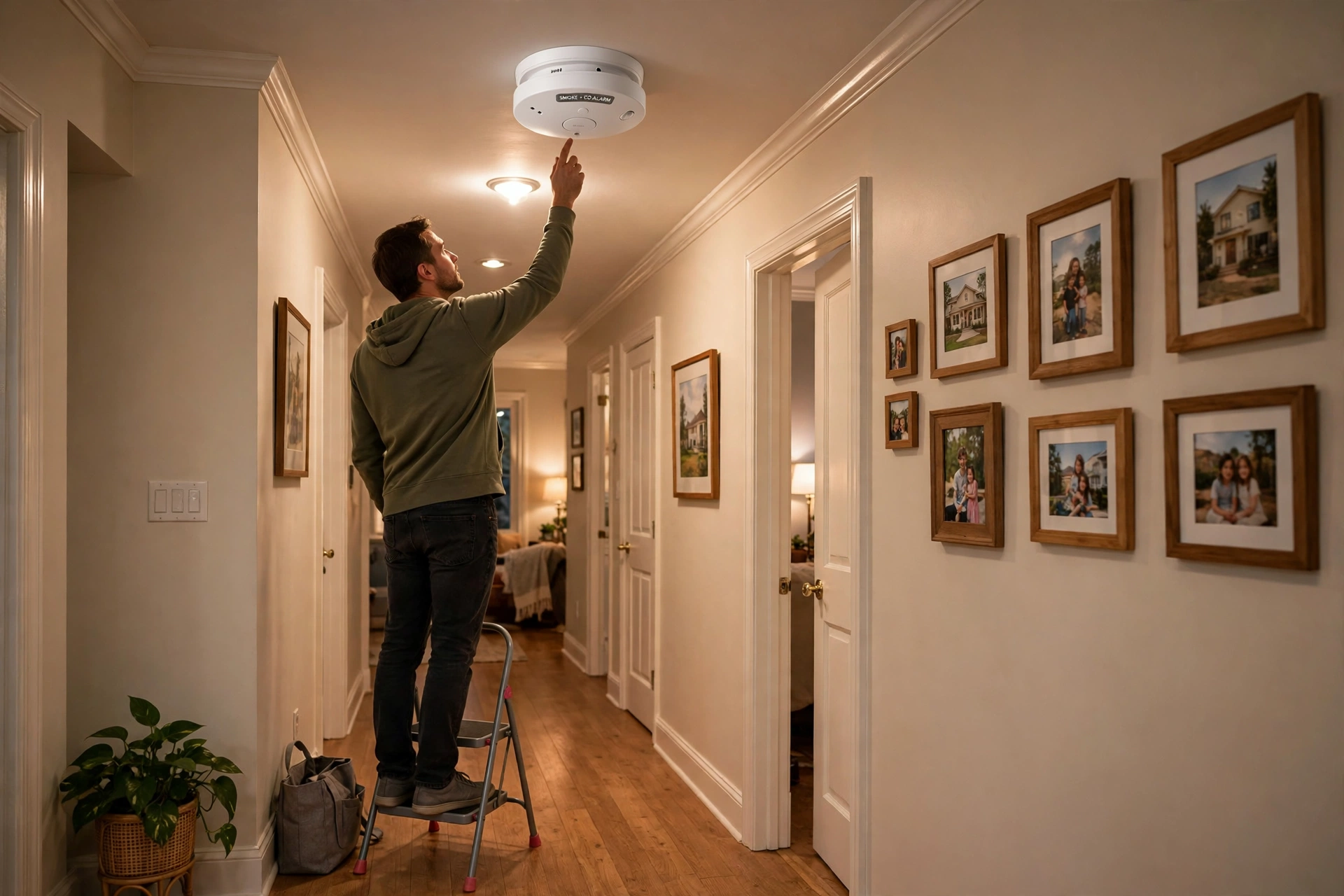
Pressing the test button proves the siren works. It says nothing about the sensor, and the sensor is the part with the expiry date. Pull each alarm down (most twist off their bracket) and read the date on the back:
- Smoke alarm older than 10 years: replace it, even if it tests fine.
- CO alarm older than 5–7 years (the maker prints the limit): replace it.
- No date printed: it predates date labelling, which means it is old enough to replace on sight.
If several alarms went up when the house was built, they will all expire together — budget for the set, not the one that happens to chirp first. A combination unit is the clean replacement for most rooms: one device, both sensors, and a sealed lithium battery rated for the alarm’s whole life, so the 2 AM low-battery chirp simply stops being a thing that happens in your house.
Combination Smoke & CO Alarm, 10-Year Sealed Battery
Both sensors in one unit, a sealed battery that lasts the alarm’s full 10-year life, and no battery drawer for anyone to borrow from.
→ Click here to check price on Amazon
Step 2: The coverage map — one per level is the floor, not the goal
The standard worth building to: an alarm on every level of the house including the basement, inside every bedroom, and in the hallway outside every sleeping area. The bedroom doors matter — a hallway alarm waking through a closed door is a much quieter alarm, which is why the inside-the-bedroom unit exists. Fuel-burning appliances get a CO ear nearby too: the furnace room and the water heater (the appliance our water heater maintenance guide just had you flush and inspect) should never be the one corner of the house nobody is listening to.
The weakness in a house full of standalone alarms is that they do not talk to each other — a basement alarm at full volume is a murmur on the second floor. Interconnected alarms fix that: when one sounds, they all sound. Wireless sets do it without running wire, which makes them the realistic retrofit for an existing house.
Wireless Interconnected Smoke Alarms (multi-pack)
One alarm trips and every unit in the house sounds — the basement fire gets announced in the bedrooms at full volume, not through two floors of muffle.
→ Click here to check price on Amazon
Step 3: The kitchen — a blanket for the fire you can see coming
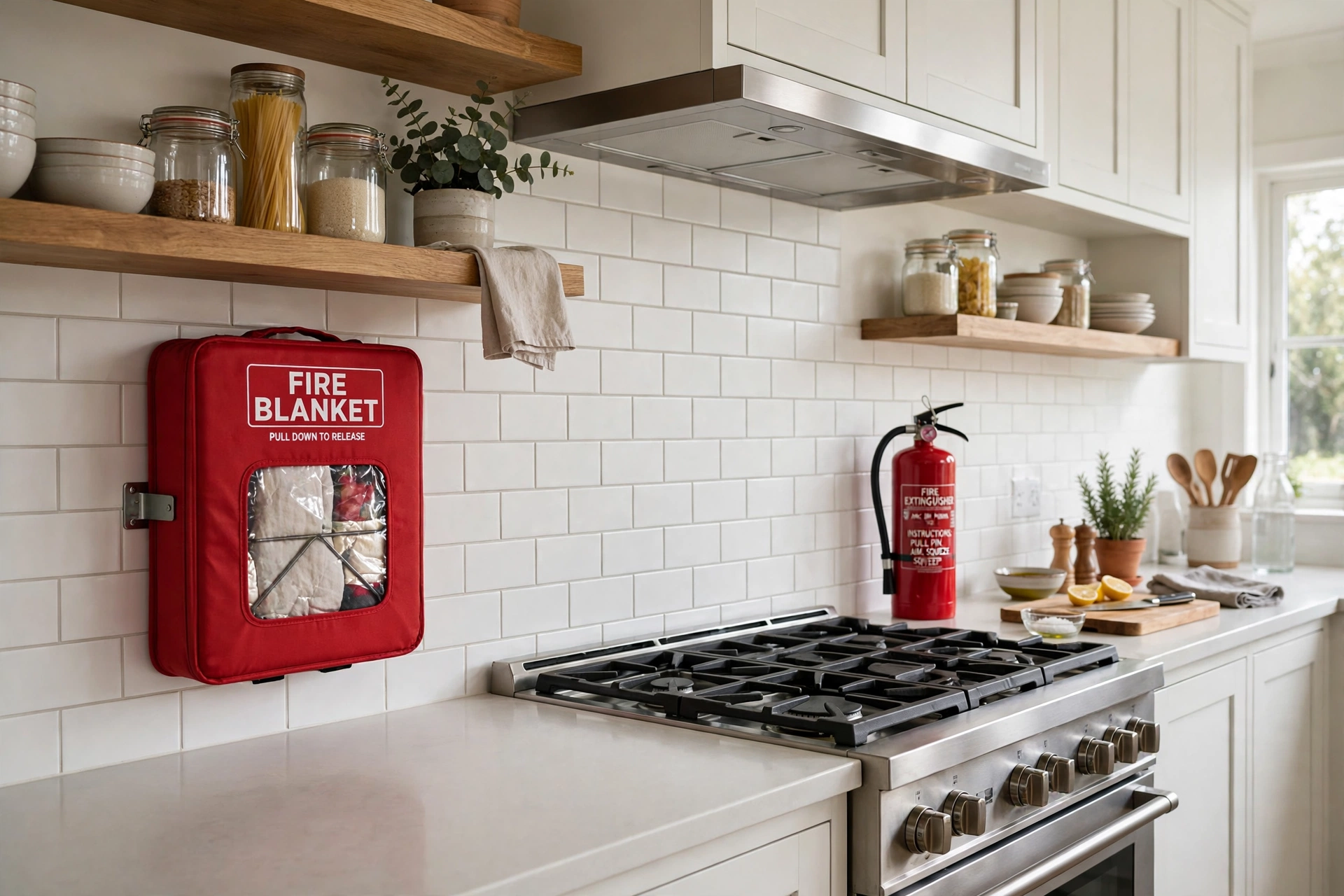
Most house fires start in the kitchen, and the classic kitchen fire — oil in a pan — is the one you must never put water on. A fire blanket is the kitchen-specific tool: pull it down, drape it over the pan, and it smothers the flame with no mess, no aim, and no decision-making under panic. It hangs on a wall or cabinet door and takes up less room than a cutting board. Keep the lid rule too — sliding a pan lid on works the same way — but the blanket covers the bigger pan and the person’s hands at the same time.
Fire Blanket for Kitchen (wall-mount)
Pull, drape, done: smothers a stovetop grease fire without water and without the powder cloud of an extinguisher — sized for the fire that actually happens in most houses.
→ Click here to check price on Amazon
Step 4: The extinguisher — one on every level, where you can reach it standing back
Alarms warn; an extinguisher is what you do in the first thirty seconds, and only then — fire growing or smoke banking down means get out and call from outside, full stop. For the house, a multi-purpose (ABC) extinguisher in the 5-pound range is the size a person can actually handle and aim: kitchen-adjacent (not directly over the stove, where the fire would be between you and it), garage door, and one upstairs if bedrooms are up there. Learn the PASS motion before you need it — Pull the pin, Aim at the base of the fire, Squeeze, Sweep — and check the gauge needle is in the green once a year, on the same day you check the alarm dates.
Multi-Purpose Home Fire Extinguisher (ABC, 5 lb)
Rated for wood, liquids, and electrical fires, wall bracket included — the size that lives by the kitchen door and the garage entry without getting in the way.
→ Click here to check price on Amazon
Step 5: The way out — if bedrooms are upstairs, the ladder is not optional
Every alarm above buys time, and time only helps if there is somewhere to go. A second-floor bedroom whose window is the backup exit needs an escape ladder rolled under the bed or hooked in its box beside the window — chain or rope, rated for the drop, and practised once in daylight so the first deployment is not at 3 AM in smoke. Walk the plan once with the household: two ways out of every room, one meeting spot outside, and nobody goes back in. It takes ten minutes, which is exactly why our space heater guide keeps coming back to the same point — winter safety gear only works if it is in place before the night it is needed.
Two-Story Fire Escape Ladder
Hooks over the windowsill and drops a rated climb to the ground — the upstairs bedrooms’ second exit, stored rolled beside the window it serves.
→ Click here to check price on Amazon
Detectors, settled
Read the dates and replace what has expired, cover every level and every bedroom, interconnect so the whole house hears it, put a blanket in the kitchen and an extinguisher where a person can reach it, and give upstairs bedrooms a way down. An hour on a Saturday, once a year — against the two emergencies a house genuinely cannot improvise its way through.
Leave a Reply