Built & Backyard is reader-supported: we may earn a commission from qualifying purchases made through links on this page, at no extra cost to you.
A space heater is the cheapest way to fix the one cold room in the house — the back bedroom, the home office over the garage, the bathroom on a 45-degree morning — without paying to heat every room to match. It is also the appliance that causes trouble when it is treated like a lamp: plugged into a power strip, parked against the curtains, and left running on the same circuit as everything else. The good news is that safe and warm are the same set of rules, and they are simple. Size the heater to the room, give it its own circuit and its three feet of clearance, and let a thermostat — not the breaker — do the cycling. If your cold spot is the garage instead, start with our garage heater sizing guide; this guide is for the rooms inside the house.
Quick answer
Almost every plug-in space heater is 1,500 watts, which draws 12.5 amps — most of a standard 15-amp circuit by itself. Run one heater per circuit, plug it directly into the wall (never a power strip or extension cord), keep it three feet from anything that can burn, and pick the type by room: oil-filled radiator for a quiet bedroom, ceramic tower for fast living-room heat, and only an ALCI-plug heater made for bathroom use in the bathroom.
Step 1: The breaker math — why two heaters trip the house
Watts are watts: a “small” 1,500W heater and a “big” 1,500W heater draw exactly the same current. On a 15-amp circuit, one heater leaves almost nothing for anything else on that circuit — add a second heater, a hair dryer, or a microwave on the same run and the breaker does its job. So the sizing question is not really about the heater; it is about the room and the circuit:
- Up to about 150 sq ft (bedroom, office, bathroom): one 1,500W heater on its own circuit is plenty, and on low (750W) it will hold the room overnight.
- 150–300 sq ft (living room, open den): one 1,500W heater with a fan or oscillation covers it if the doors stay mostly closed; expect it to take the chill off, not make it a sauna.
- Bigger or drafty rooms: fix the drafts first — our weatherstripping guide is cheaper than a second heater, and a second heater on the same circuit is a tripped breaker anyway.
Step 2: The bedroom — silent heat that holds all night
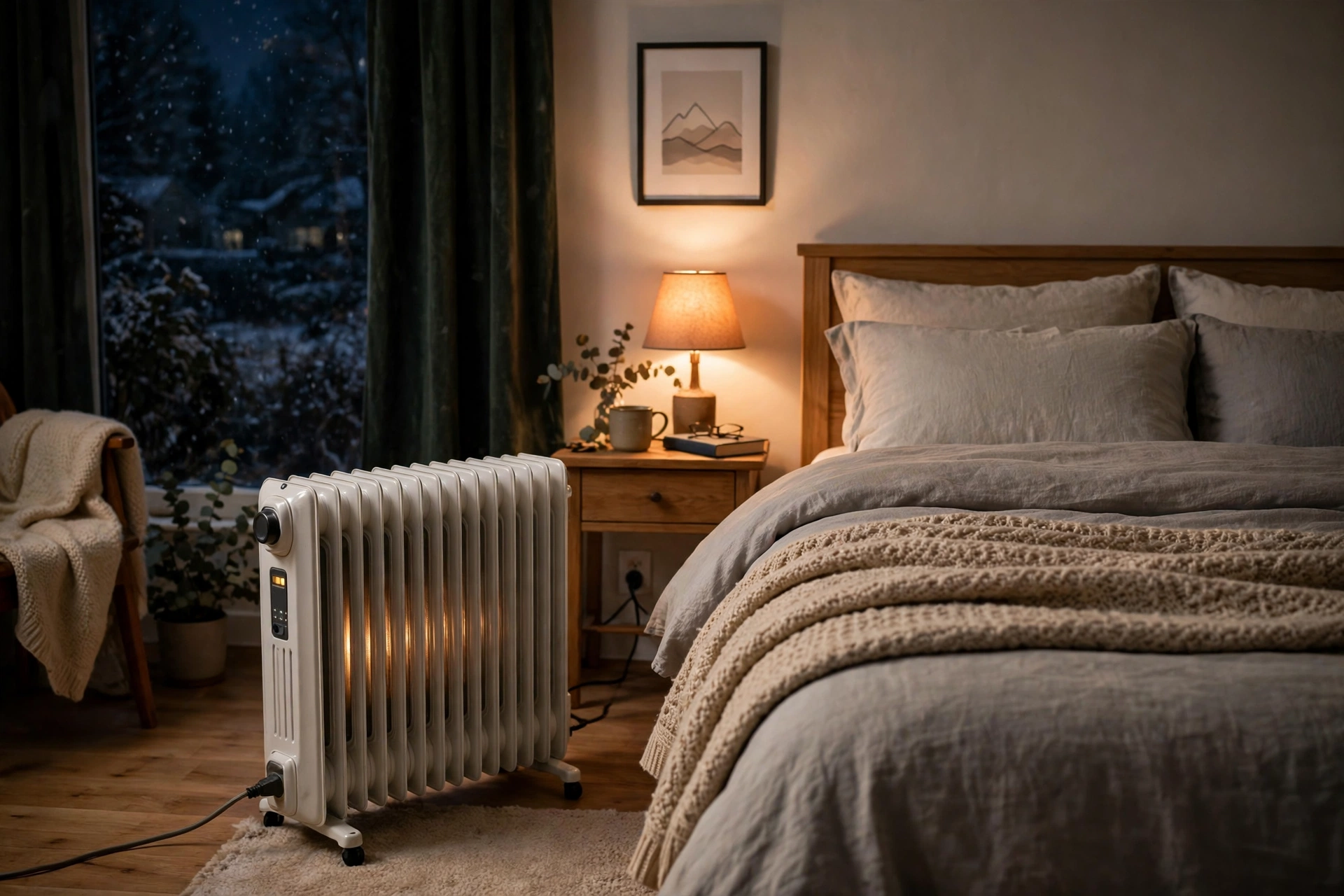
A bedroom heater should be silent, steady, and boring. Fan-forced ceramics cycle on and off and click and hum; an oil-filled radiator just radiates, holds its heat through the off-cycles, and has no fan to dry the air or keep you awake. Run it on low with the thermostat set once, and it will hold a bedroom through a 40-degree night without ever working hard.
Oil-Filled Radiator Space Heater with Thermostat
Sealed oil, no fan, no exposed element, and heat that keeps radiating after the thermostat clicks off — the bedroom heater, and the safest choice around kids and pets because the surface stays warm, not glowing.
→ Click here to check price on Amazon
Step 3: The living room — fast heat where people actually sit
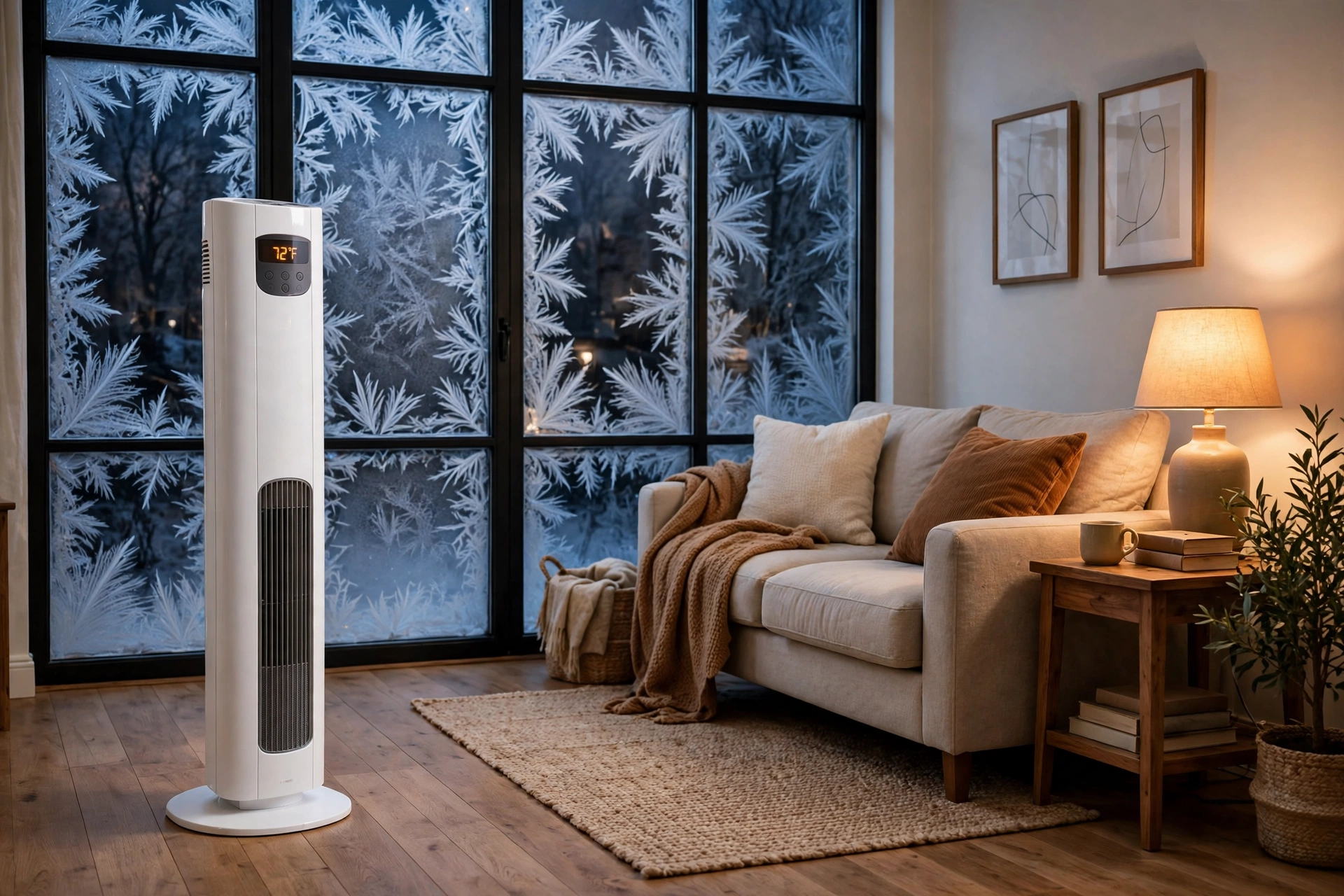
Living rooms want speed and spread: a ceramic tower with oscillation warms the couch zone in minutes and sweeps instead of blasting one spot. Look for tip-over and overheat shutoff (both are non-negotiable, on every pick in this guide), a real thermostat rather than just high/low, and a remote so it gets turned down instead of left roaring.
Ceramic Tower Space Heater with Thermostat, Remote & Oscillation
Ceramic elements heat fast and cool fast when tipped or blocked, the tower footprint tucks beside a couch, and oscillation covers a seating area instead of one pair of ankles.
→ Click here to check price on Amazon
Step 4: The bathroom — the one room with its own plug rule
Water changes the rules. A bathroom heater should be built for the room: an ALCI safety plug (the kind with the test/reset buttons, like a hair dryer’s) that cuts power if it meets water, a compact body that sits on the counter or floor away from the tub, and a habit — heat the room while you shower, unplug it when you leave. Never run a regular bedroom heater in a bathroom, and never run any heater where it can be knocked into a sink or tub.
Bathroom Space Heater with ALCI Safety Plug
Made for the one damp room in the house: ALCI plug protection, quick ceramic heat for the morning shower window, and a small footprint that stays clear of towels and water.
→ Click here to check price on Amazon
Step 5: Let a thermostat do the cycling — and back it up with a CO alarm
Two habits separate a safe setup from a lucky one. First, temperature control: a heater with a built-in thermostat is the baseline, and a thermostat outlet takes it further — it cuts power at the set temperature and restores it when the room dips, which is how you heat a room you are not sitting in (a nursery, an elderly parent’s room, a pump room on a freeze-watch night like the nights our outdoor faucet guide is built for) without running full blast for eight hours.
Thermostat-Controlled Outlet Plug for Heaters
Plug the heater through it, set the temperature, and the outlet cycles power to hold the room there — the set-and-forget control a basic heater’s dial only guesses at. Use it only with a heater that resumes heating when power returns (a mechanical-dial model), and never as an excuse to leave a heater running in an empty house.
→ Click here to check price on Amazon
Second, the alarm that covers the other kind of heat: if anything in your home burns fuel for backup heat — a gas fireplace, a ventless heater, a generator outside the window during an outage (see our generator sizing guide) — a working carbon monoxide detector on every sleeping level is the rule, not the upgrade. Our fireplace and chimney safety guide covers the hearth side of the same winter.
Carbon Monoxide Detector, Plug-In with Battery Backup
Plug-in with a battery that carries it through the outage — which is exactly when fuel-burning backup heat is running and CO risk is highest.
→ Click here to check price on Amazon
The non-negotiables, every time
- Wall outlet only. No power strips, no extension cords, no smart plugs not rated for a 1,500W resistive load. If the cord cannot reach, move the heater.
- Three feet of clearance — from bedding, curtains, furniture, paper, and the laundry basket. Most heater fires start as a clearance problem.
- Flat floor, never furniture, and never in a walkway where the cord becomes a trip line.
- Off when you leave, off when you sleep — unless it is the oil-filled on low, which is the one setup in this guide designed for overnight holding. Even then: clearance, wall outlet, working smoke alarm.
- Tip-over and overheat shutoff or do not buy it. Both are standard on every pick above; if a heater lacks either, it is not a bargain at any price.
Space heaters, settled
One heater, one circuit, straight into the wall, three feet of air around it, and the type matched to the room — radiator for the bedroom, tower for the living room, ALCI for the bathroom. Do that and the cold room is just warm, which is all anyone was asking for.
Leave a Reply