Built & Backyard is reader-supported: we may earn a commission from qualifying purchases made through links on this page, at no extra cost to you.
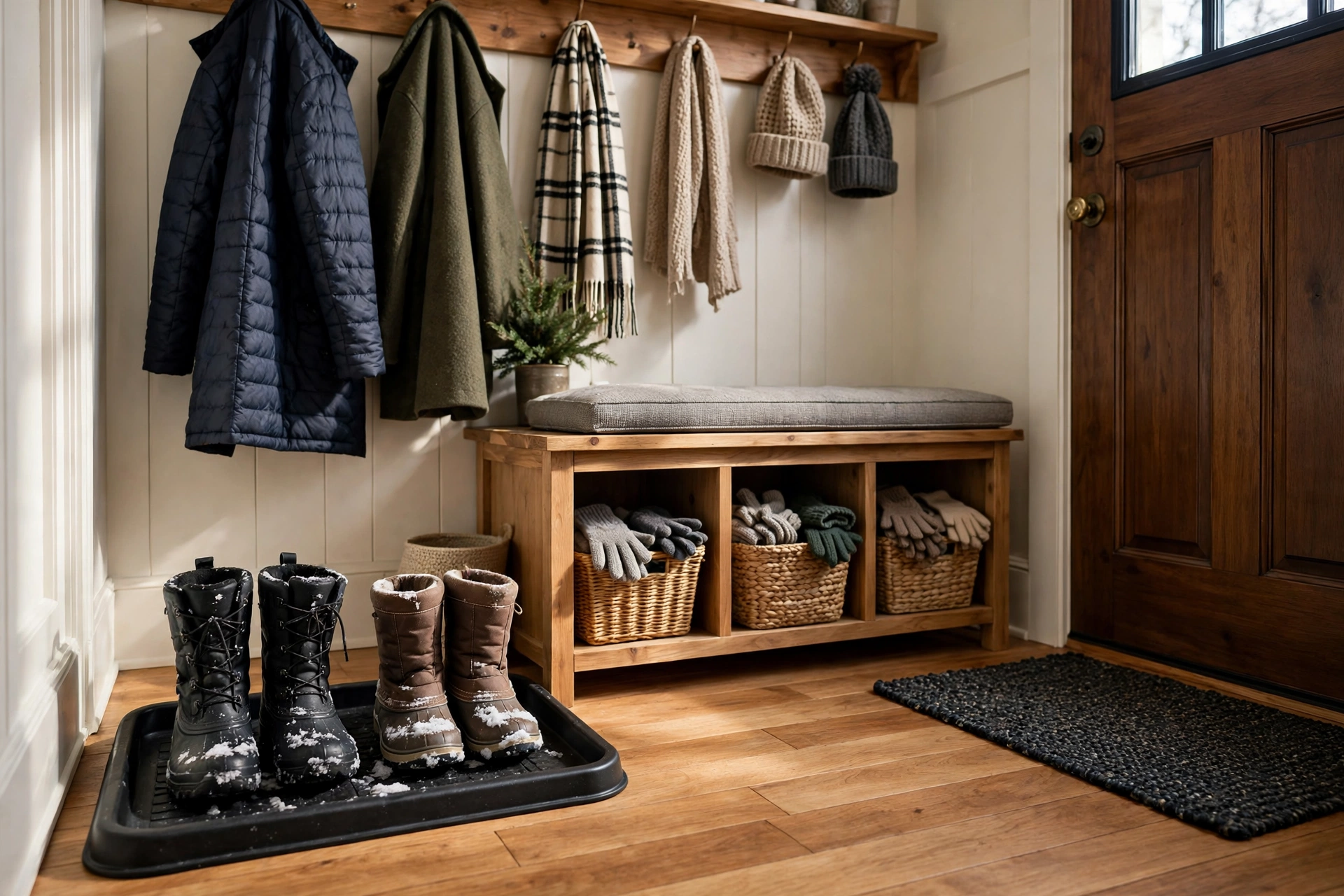
Every winter, the same thing happens at the front door: snow melts off boots into a grey puddle, road salt dries into white crust on the floorboards, and wet gloves end up draped over whatever is closest. The mess isn’t really a cleaning problem — it’s a layout problem. A winter entryway that works is built in zones: a door zone that scrapes and catches, a dry zone that gets boots and gloves actually dry overnight, and a storage zone that gives every coat, hat, and pair of boots a home within two steps of the door. Set the zones up once, in November, and the meltwater stops at the mat instead of migrating down the hallway until March. It matters even more in the holiday stretch, when the same door handles guests — our holiday guest prep guide covers the rest of the house once the entryway is under control.
Quick answer
Work in three zones. At the door: a heavy scraper mat outside and a large boot tray with a raised lip inside, so snow and slush land in the tray instead of on the floor. In the dry zone: an electric boot dryer that gets boots and gloves dry overnight — dry boots are warm boots, and they don’t grow mildew. In the storage zone: a hook rail at two heights and a bench with cubbies, so everything comes off in one spot and stays there. Then run a five-minute salt routine — shake the tray out, wipe the salt line before it dries — and winter stays at the door where it belongs.
Zone 1: The door zone — mat and boot tray
The door zone has one job: strip as much snow, slush, and grit off footwear as possible in the first three steps inside. Two layers do it:
- A scraper mat outside the door. Coarse, aggressive texture — rubber or heavy coir — that knocks packed snow out of boot treads before anyone comes in. It lives outside, takes the worst of the weather, and gets shaken or hosed off weekly. A smooth decorative mat here does almost nothing; you want tread-scraping bite.
- A boot tray inside the door. This is the single highest-value item in the whole setup. Boots come off onto the tray, and the tray’s raised lip holds the meltwater — a pair of snow boots can shed a surprising amount of water as they warm up. Size it honestly: a tray around 35–40 inches long holds two pairs side by side; a household of four in real winter needs two trays or one tray plus a mat extension.
- Position matters more than price. The tray goes exactly where boots naturally come off — tight to the wall beside the door swing, not across the room where nobody will walk to it. If people have to carry dripping boots to the tray, the system fails by Tuesday.
Zone 2: The dry zone — boot dryer and drip habits
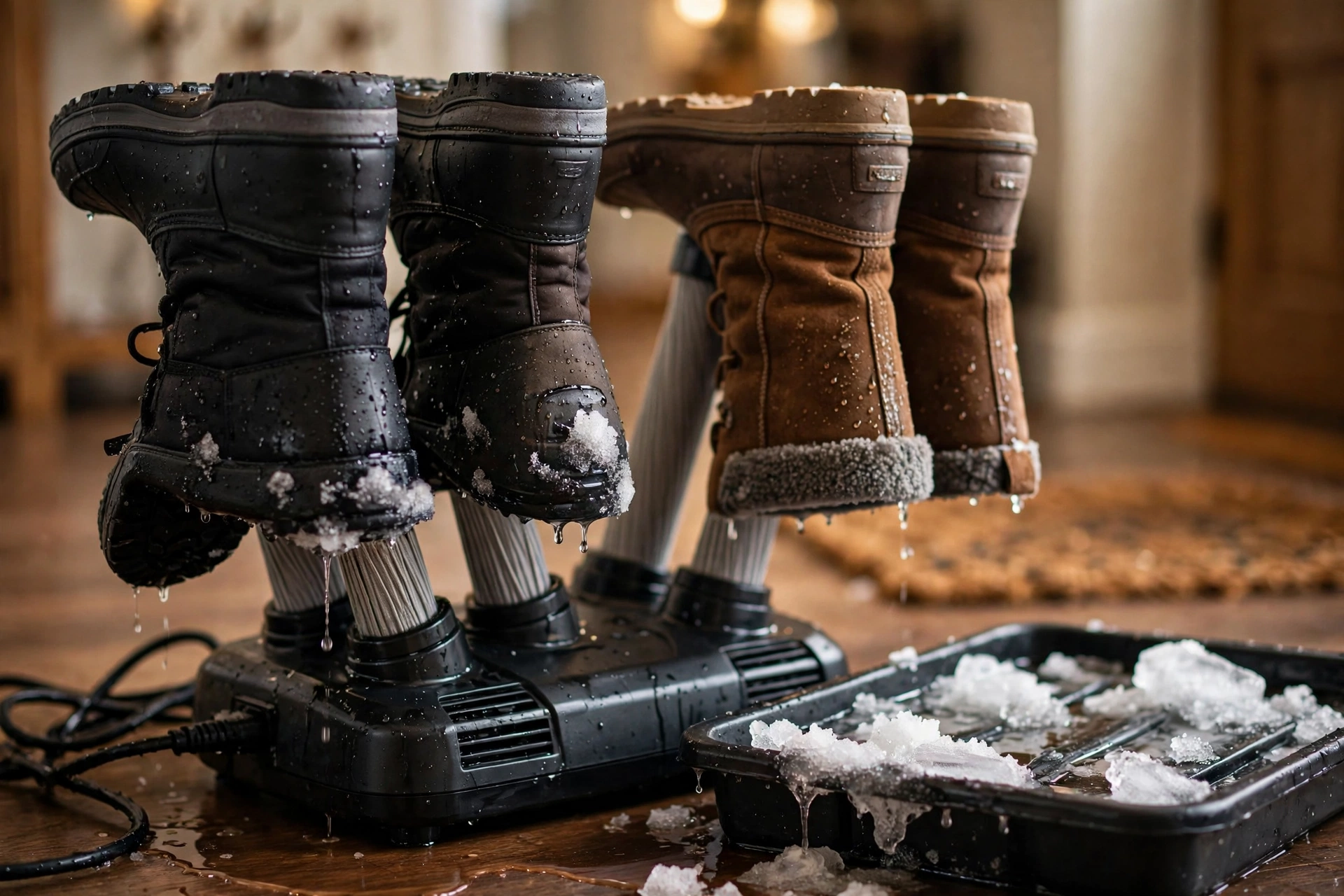
Wet boots put back on in the morning are cold boots, and boots that stay damp inside for weeks grow the smell that no spray fixes. The dry zone fixes the overnight half of the problem:
- An electric boot dryer does the real work. The good ones push gently warmed air up through drying tubes — enough heat to dry a soaked pair overnight, not enough to cook leather or warp liners. Two-pair models handle boots on one set of tubes and gloves or mittens on the other, which is exactly the combination that comes in from shoveling. Look for a timer or auto shut-off so it isn’t running all day.
- Newspaper is the backup, not the plan. Crumpled newspaper wicks moisture and helps in a pinch, but it’s a nightly chore that stops happening by January. The dryer is a habit you don’t have to remember — boots go on it as part of taking them off.
- Drip habits for everything else. Ice cleats, the dog’s towel, and wet hats all need a defined drip spot too — a hook or a corner of the tray — or they migrate to the kitchen chairs. Give meltwater one legal place to land and it mostly stays there.
Zone 3: The storage zone — hooks, bench, and baskets
If coats and gear don’t have a home within arm’s reach of the door, they pile on the nearest chair. The storage zone is what makes the other two zones survive contact with a real family:
- A hook rail at two heights. Adults’ coats at five to six feet, a second lower row around three feet for kids and for the dog leash, hats, and bags. Hooks beat hangers in winter — a wet coat goes on a hook with one cold hand, and air circulates so it dries instead of steaming in a closet. Mount the rail into studs; winter coats are heavy and drywall anchors will eventually lose.
- A bench you can sit on. Putting on winter boots is a seated job. A storage bench with cubbies underneath does triple duty: a seat for booting up, cubbies that give every person a bin for hat and gloves, and a top surface that catches mail and keys instead of the kitchen counter.
- One basket for the overflow. Scarves, extra gloves, the umbrella — a single open basket by the bench corrals the small stuff that otherwise spreads across the whole entryway. One basket, not five: when it fills, something gets put away properly.
The salt-and-grit routine
Road salt is the quiet floor-killer in all of this. Left alone, the brine that melts off boots dries into a white crust, and the grit in it grinds into hardwood and laminate finishes with every pass. Five minutes, a few times a week, prevents it:
- Shake the tray outside before the meltwater in it gets deep enough to slosh — thirty seconds, twice a week.
- Wipe the salt line while it’s damp. Salt residue wipes up easily with a damp mop the day it appears and needs scrubbing once it has dried and re-wet a few times. A splash of white vinegar in the mop water cuts the white film on hard floors.
- Keep the outside steps treated so less gets tracked in to begin with — our ice melt and walkway safety guide covers which melts are safe for concrete, pavers, and pet paws.
- Rinse the scraper mat when it cakes up; a mat packed solid with grit stops scraping and starts stamping it onto boots instead.
The gear that makes it work
Electric Boot Dryer (Forced-Air, Two-Pair, with Timer)
The engine of the dry zone: warmed air on drying tubes gets soaked boots and gloves dry overnight, so mornings start warm and the mildew smell never gets a foothold.
→ Click here to check price on Amazon
Large Boot Tray with Raised Lip
The highest-value piece in the setup — boots come off onto it, the lip holds the meltwater, and the puddle stays in the tray instead of spreading across the entry floor.
→ Click here to check price on Amazon
Heavy-Duty Scraper Door Mat
The first line of defence outside the door: coarse tread-scraping texture that knocks packed snow and grit out of boot soles before anyone steps inside.
→ Click here to check price on Amazon
Wall-Mounted Coat Hook Rail
Two rows of sturdy hooks — high for coats, low for kids and leashes — so wet winter gear hangs, dries, and stays in one place instead of colonizing the furniture.
→ Click here to check price on Amazon
Entryway Storage Bench with Cubbies
A seat for booting up, cubbies that give every person a bin for hat and gloves, and a surface for keys and mail — the piece that turns a pile zone into a system.
→ Click here to check price on Amazon
The short version
Scraper mat outside, boot tray inside, boots off onto the tray. A boot dryer running overnight so everything starts the day dry. Hooks at two heights and a bench with cubbies so gear lands in one spot and stays there. Then shake the tray, wipe the salt before it dries, and keep the steps treated. None of it is expensive or complicated — it’s three zones and a five-minute routine, and it’s the difference between an entryway that handles winter and a hallway that shows it.
Leave a Reply